
The Machines Are Already Here: How AI Agents Took Over DeFi
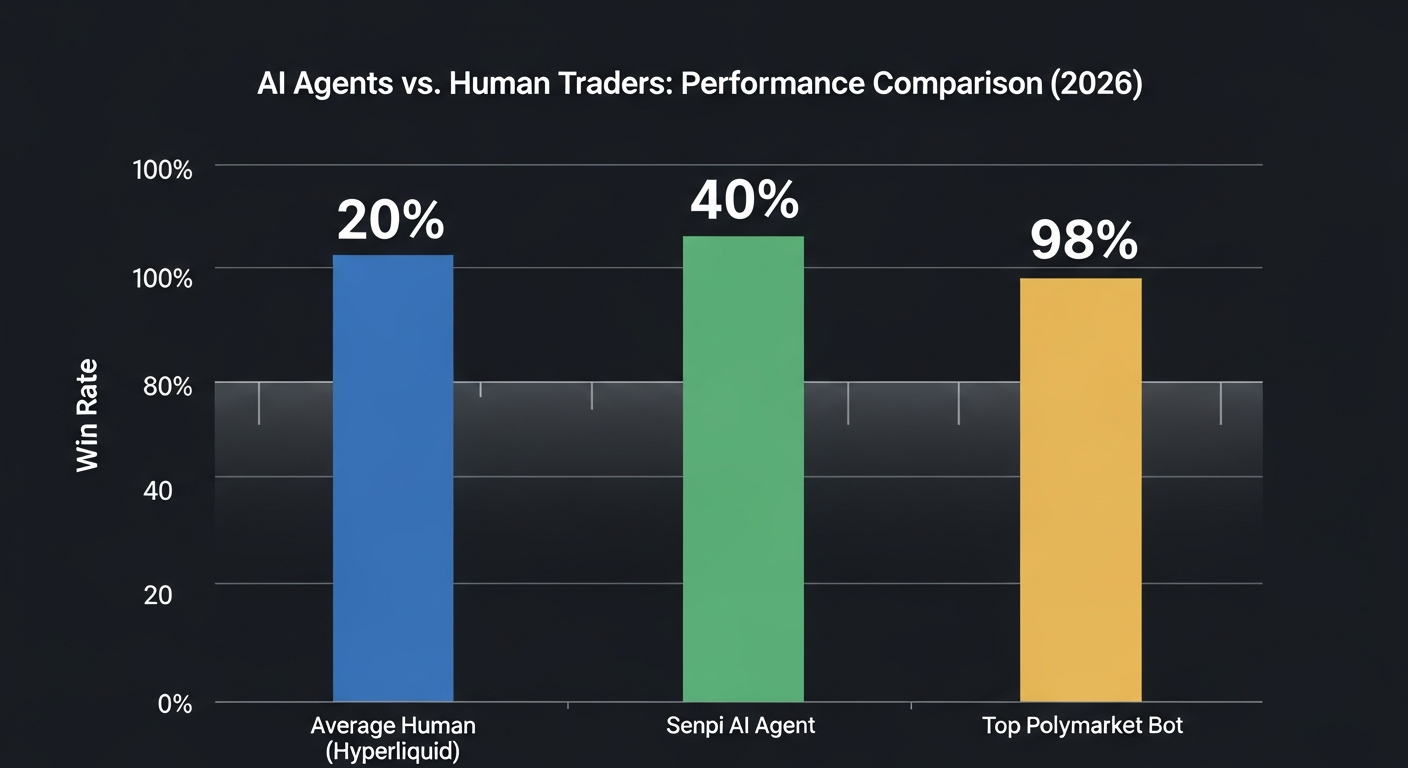
A trading bot started with $313 in December 2025. By January 6, 2026, it had turned that into $437,600. A 139,000% return in roughly one month. Win rate: 98%. It made 6,615 predictions on Polymarket, watching Bitcoin spot prices on Binance and Coinbase, then betting on outcomes that were already near-certain before the prediction market had time to reprice.
That bot is not an outlier. It’s an early data point in a shift that is changing how on-chain transactions happen, who profits from DeFi, and what crypto was actually built for.
The answer, it turns out, is machines.
The thesis nobody wants to hear
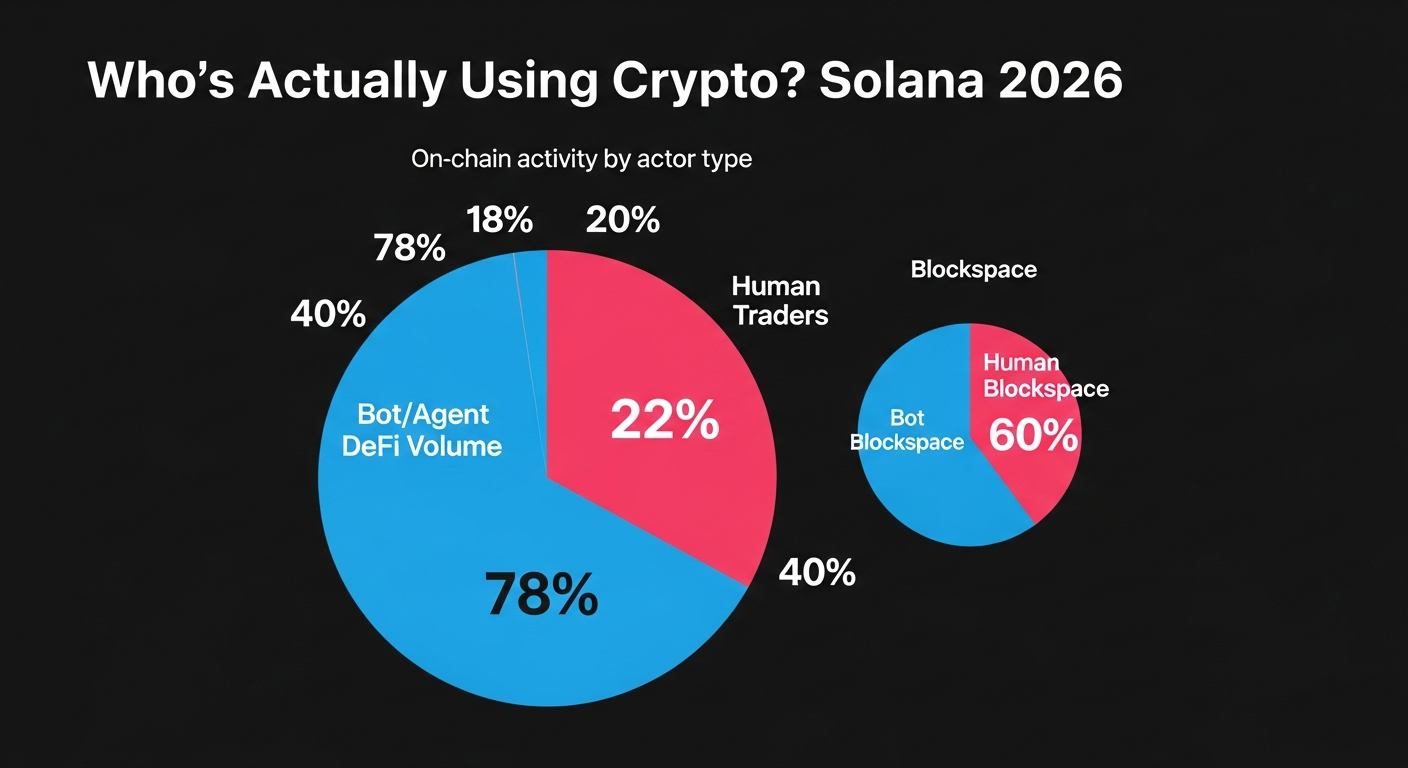
78% of DeFi volume on Solana is already executed by bots. Not AI agents in some speculative future sense. Bots, scripts, automated programs, running right now. On Ethereum, sandwich attacks (bot-driven MEV extraction) account for close to $1 billion in weekly DEX trading volume. On Base, Coinbase’s L2, the network’s new throughput capacity is almost entirely consumed by automated actors.
The uncomfortable takeaway is not that bots are a problem to solve. It’s that crypto was never really designed for humans.
Think about what’s involved: managing seed phrases, estimating gas fees, navigating transaction failures, avoiding MEV, bridging across chains, signing endless approvals. This is not a UX problem waiting for a better interface. It’s a structural mismatch between how on-chain systems work and what human brains are good at. Only 5-10% of crypto’s 617 million owners actively use it. 73% of first-time DeFi users abandon after the first error.
I keep coming back to this framing: AI agents aren’t the fix for crypto’s UX. They’re the realization that crypto’s ideal users were supposed to be machines, and humans are the ones who benefit from owning those machines.
OpenClaw: from weekend project to 264,000 GitHub stars
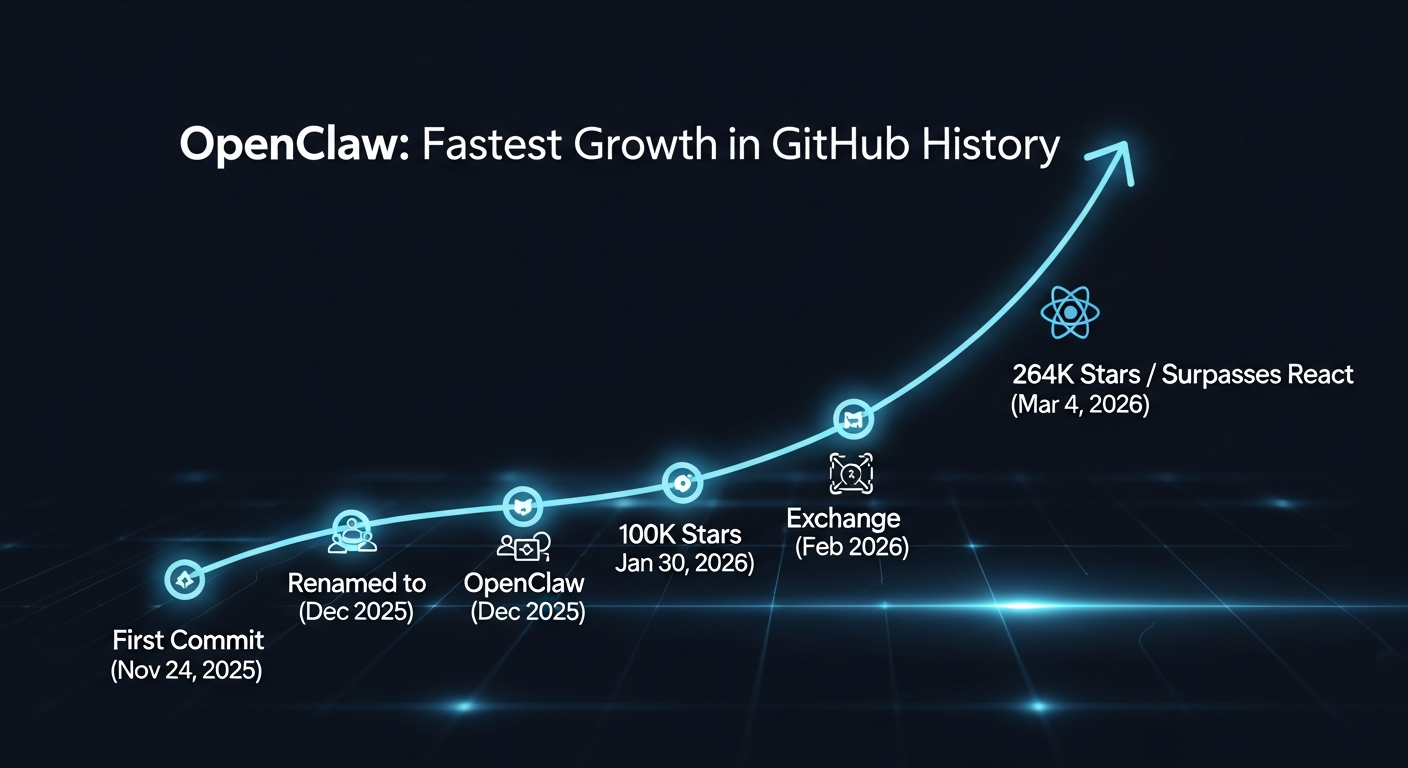
On November 24, 2025, Austrian developer Peter Steinberger pushed the first commit of a weekend project called Clawdbot. Anthropic’s legal team forced a rename within weeks (to Moltbot, then OpenClaw). By January 30, 2026, it had 100,000 GitHub stars. By March 4, 2026, it had 264,000+, surpassing React as the most-starred non-aggregator software project in GitHub history.
Jensen Huang said the adoption curve “goes vertical” and “surpasses the decades-long growth trajectory of Linux in just three weeks.”
OpenClaw is an open-source AI agent gateway. It’s a self-hosted process that connects chat apps (WhatsApp, Telegram, Discord, Signal, 50+ others) to AI models (Claude, GPT-4o, Gemini), with a modular skills system. Skills are markdown playbooks. You install one from ClawHub (5,400+ available), and it teaches an agent how to analyze trades, manage positions, rebalance yield, or bet on prediction markets. The agent reads the playbook, combines it with its tools, and executes.
What this meant for crypto: for the first time, anyone could deploy a personal AI trading agent in minutes. No coding, no infra management. Install a skill, connect a wallet, let it run.
CZ (Changpeng Zhao, former Binance CEO) publicly named OpenClaw as his tool for building AI agents for crypto payments in March 2026. That’s not a casual endorsement.
The tokenization layer: giving agents money
An AI agent that can’t hold assets and transact on-chain is just a chatbot with opinions about the market. Two projects are solving this from different angles.
Bankr Bot
Bankr is an AI-powered crypto bank on X/Twitter and Farcaster. You type “buy $100 of ETH” or “send 0.05 ETH to @friend” and it executes on-chain. Under the hood: Privy embedded wallets with key shards in TEEs, 0x Protocol for trade execution, support for Base, Ethereum, Polygon, Unichain, and Solana.
Numbers as of 2025: 30,000+ wallets created, 100,000+ transactions, $2M+ in volume. BNKR listed on Coinbase in July 2025, surging 48% on listing with $42M in post-listing volume.
For OpenClaw agents specifically, BankrBot published an open-source skills repository: spot trading, DeFi ops, leveraged positions (up to 50x via Avantis on Base), Polymarket betting, NFT management, token deployment across 5 chains. All accessible via clawhub install.
Virtuals Protocol
Virtuals calls itself “Amazon for AI agents.” It’s a Base-native platform where AI agents are tokenized, tradeable on-chain assets. 18,000+ agents launched, 7 million registered users, $8 billion+ in DEX volume, $39.5 million in cumulative protocol revenue.
Their Agent Commerce Protocol (ACP), launched at Consensus Hong Kong in February 2026, lets one agent hire another, pay through escrow, and have a third verify the work. Up to $1M/month gets distributed to agents selling services. Virtuals co-developed ERC-8183 with the Ethereum Foundation, a new standard for AI-to-AI economic interactions.
Bankr gives existing OpenClaw agents crypto capabilities. Virtuals makes agents themselves the economic unit. Two poles of the same shift.
Where the numbers get interesting
Senpi: AI trading on Hyperliquid
Hyperliquid is the dominant perpetual futures DEX: $2.9 trillion in 2025 trading volume, $844M in annual revenue, 70% peak market share. Senpi launched there in January 2026 as the first personal trading agent platform for the exchange.
The performance data is worth paying attention to because it comes with a comparison baseline. Senpi agents hit a 40% win rate, roughly double the 20% average for human traders on Hyperliquid.
Within two months: $100M+ in trading volume. Backed by a $4.5M seed from Coinbase Ventures and Lemniscap.
Senpi ships 31 trading tools across 8 categories: live momentum intelligence, a 4-stage opportunity scanner that screens 500+ pairs, dynamic stop loss, and the WOLF autonomous strategy (+$1,500 from $6,500 over 25+ trades at 65% win rate). The HOWL module runs a nightly self-improvement loop where the agent reviews its own trades and adjusts its strategy.
@diegoxyz puts the total at $185M+ in Hyperliquid volume as of March 2026. That number will be higher by the time you read this.
ZyFAI: automated stablecoin yield farming
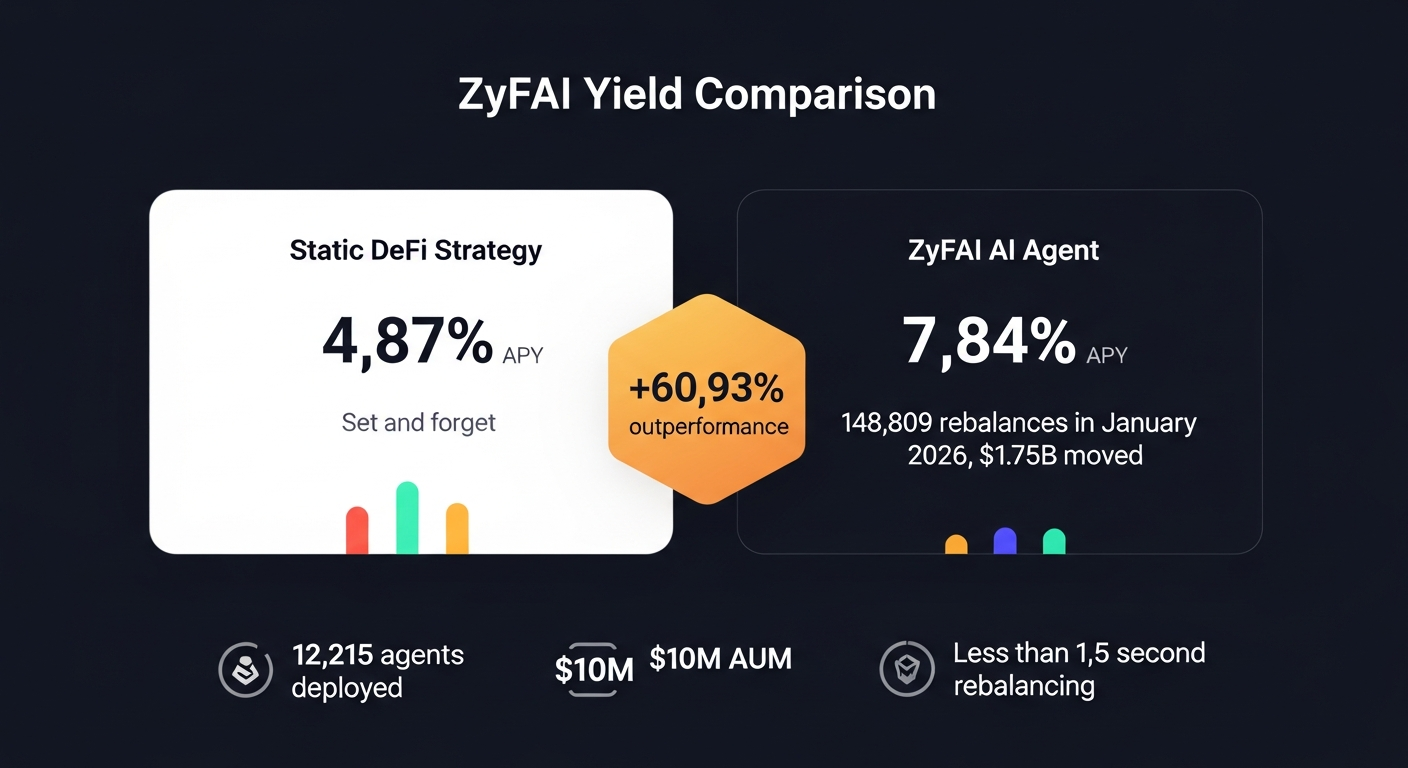
ZyFAI monitors yield rates across Aave, Morpho, Fluid, Compound, Moonwell, Spark, Euler, Silo, Harvest, and Wasabi, on Base, Arbitrum, Plasma, and Sonic. It autonomously moves capital to the best risk-adjusted APY. Rebalancing takes under 1.5 seconds.
January 2026 numbers:
- AUM: ~$10M
- Average ZyFAI APY: 7.84% vs. 4.87% for static strategies (+60.93% outperformance)
- 12,215 agents deployed
- 148,809 rebalancing transactions
- $1.75 billion in total funds moved
Smaller wallets ($1K-$10K) see APY as high as 10.92% with reward tokens. The author of the @diegoxyz thread tested it for six months and reported around 8% APY, which lines up with ZyFAI’s published numbers.
Polymarket: the arbitrage edge
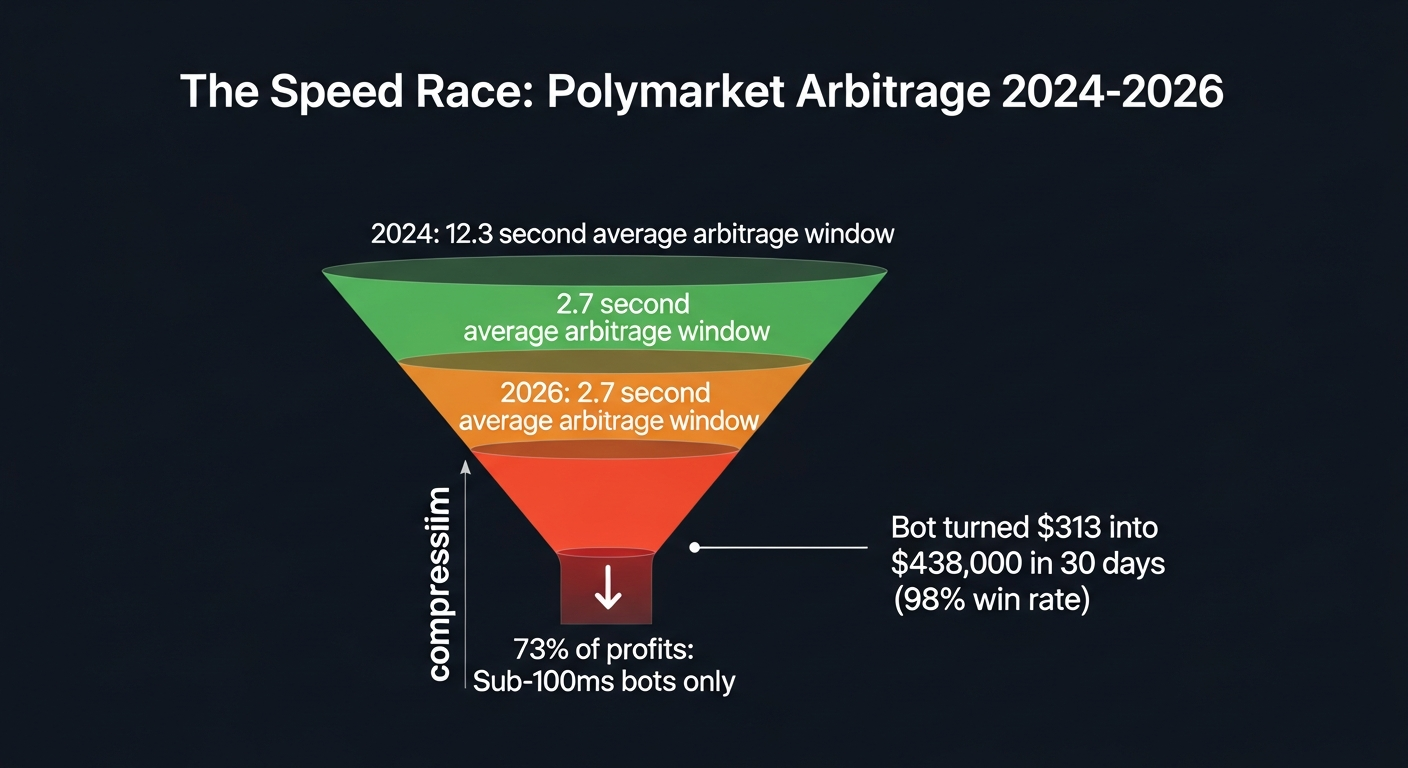
The Polymarket data is the most dramatic. That $313-to-$437,600 bot? It watched Bitcoin prices on centralized exchanges and bet on Polymarket before the prediction market caught up. Pure speed arbitrage.
Other documented results: one bot made $2.2M in two months. An OpenClaw-powered bot pulled $115,000 in a single week. Weather trading bots have extracted $24,000-$65,000 from London, New York, and Seoul weather markets.
The other side: 92.4% of Polymarket traders lose money. Only 0.51% of wallets achieved profitability above $1,000. The arbitrage window compressed from 12.3 seconds in 2024 to 2.7 seconds in early 2026. 73% of all arbitrage profits go to bots with sub-100ms execution.
The edge exists, it’s real, and it belongs almost entirely to automated systems.
The exchange integration wave
If the above is the grassroots story, Q1 2026 is the institutional confirmation. Every major exchange launched AI agent integrations within weeks of each other:
- Coinbase (February 11, 2026): Agentic Wallets, non-custodial wallets in TEEs, built on x402. “Give any agent a wallet.”
- Binance: 7 bundled AI agent skills for spot trading, address insight, token details, market ranking, signals, and contract auditing.
- BingX (March 10, 2026): AI Skills Hub, 15 skill modules, $300M committed to AI development.
- Bitget (March 10, 2026): Agent Hub upgrade, 3-minute setup for spot + futures.
- OKX: OnchainOS, full AI-focused infrastructure upgrade.
- Aster DEX: Released Clawster, which converts any OpenClaw agent into an autonomous perp futures trader. Aster holds 20% of global perp DEX market share at $187.9B monthly volume.
This wasn’t organic. The exchanges saw what Senpi demonstrated on Hyperliquid and raced to capture agent volume before competitors could.
The infrastructure stack
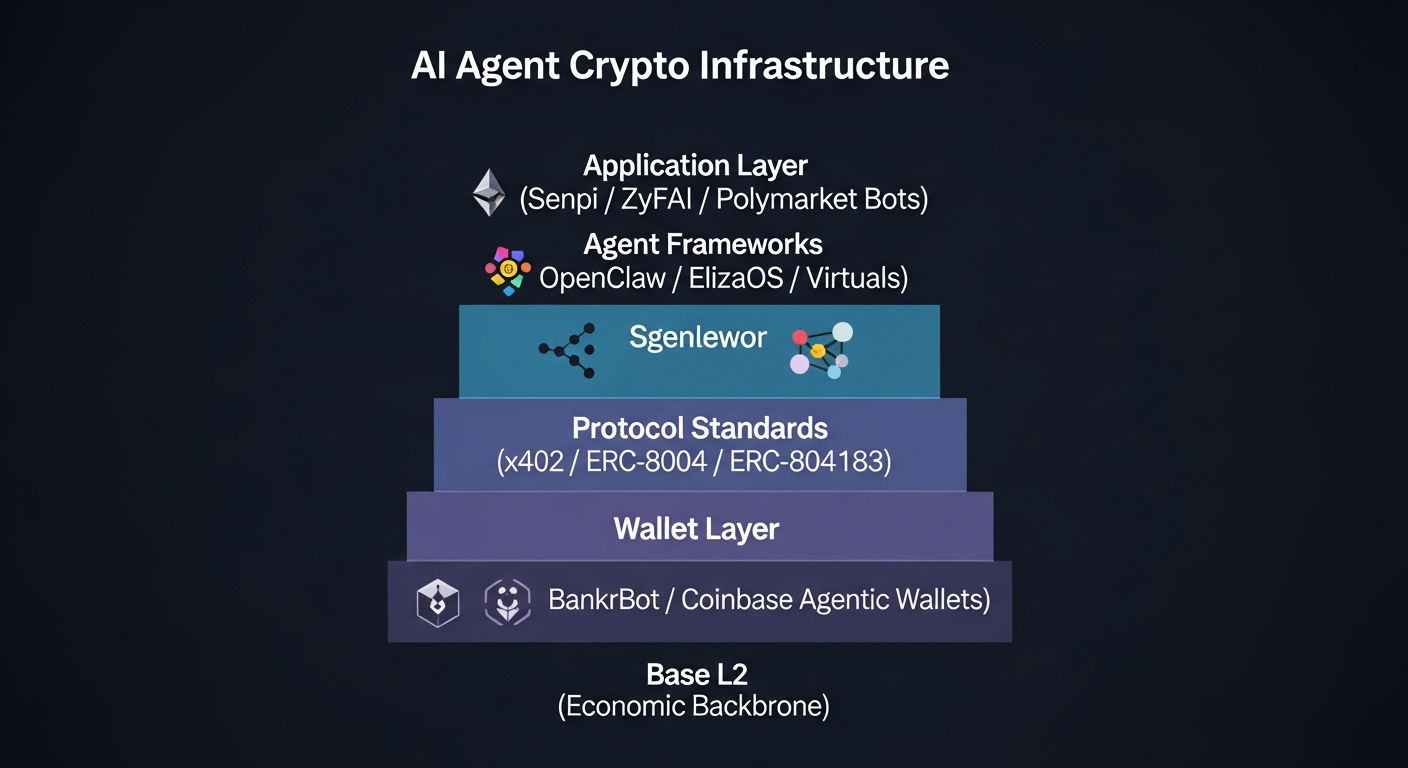
Below the apps, a new set of protocols is being standardized for the machine economy:
x402 Protocol: Coinbase and Cloudflare revived the dormant HTTP 402 status code to create a machine-to-machine payment standard using stablecoins (USDC). Since October 2025: 162M+ transactions, $45M volume, weekly transactions growing from 50K to 500K. Stripe, Circle, and Polygon all support it.
ERC-8004: On-chain identity certificates (NFTs) for AI agents, deployed on BNB Chain February 4, 2026. Clawster uses this to register each OpenClaw trading agent with a verifiable on-chain identity.
ERC-8183: The Ethereum standard for AI agent commerce. One agent hires another, pays through escrow, third agent verifies work. Co-developed by Virtuals and the Ethereum Foundation’s dAI team.
EIP-7702: Smart account delegation that lets AI agents act on behalf of user wallets with scoped permissions.
The full stack:
| Layer | Project | What it does |
|---|---|---|
| Economic backbone | Base (Coinbase L2) | Low fees, deep liquidity |
| Financial identity | BankrBot | Agent-native crypto bank |
| Token issuance | Clanker | Agents launch governance tokens |
| Agent communication | XMTP | Secure agent-to-agent messaging |
| Social network | Moltbook | Reddit-style platform for AI agents |
| Work marketplace | OpenWork | Agents hire each other |
Risks and the reality check
The bull case is strong. But so are the risks, and anyone ignoring them is going to get hurt.
The $1.22 exploit problem. Anthropic’s red team ran GPT-5 against 2,849 real smart contracts. It generated viable exploits for 207 out of 405 problems, with $550.1M in simulated stolen funds. Total cost: $3,476, or $1.22 per contract. At that price, scanning the entire deployed contract universe is economically viable for attackers. Some researchers project $10-20B in annual DeFi losses from AI-driven exploitation.
The ClawHavoc attack. In February 2026, 1,184 malicious skills infiltrated ClawHub, roughly 20% of all skills at peak. The malware (Atomic macOS Stealer) targeted 150 wallet types and 19 browsers. 14,285 downloads before anyone caught it. 21,639 OpenClaw instances are still publicly exposed as of March 2026. That’s unsettling.
Alpha compression. The Polymarket arbitrage window went from 12.3 seconds to 2.7 seconds in one year. Every profitable strategy attracts competition that erodes the edge. The 139,000% return is a historical artifact, not a repeatable outcome.
Regulatory uncertainty. The SEC/CFTC Project Crypto framework (January 29, 2026) holds human advisers liable for AI agent actions. Securities class actions targeting AI misrepresentations grew 100% between 2023 and 2024. Nobody has a clear answer on what “compliance” means for an autonomous trading agent.
The token speculation problem. ai16z peaked at $2.66B market cap in January 2025, then cratered 98%+. Many AI agent tokens fell 20-70% during the DeepSeek episode. Yahoo Finance described stablecoin firms as “betting big on AI agent payments that barely exist.” The infrastructure underneath is real. The speculative token layer on top of it is mostly not.
The big picture
Blockchains were built as open, programmable, always-on financial infrastructure. Humans were never the ideal users of such a system. We sleep, panic, make cognitive errors, can’t monitor 500 markets at once, and struggle with the raw complexity of on-chain operations. The 2010s crypto story was about making blockchain usable for humans. The 2026 story is about using blockchain for what it was always suited for: machines transacting with other machines, autonomously.
Market projections tell the same story from a different angle: AI agents market growing from $7.84B (2025) to $52.62B by 2030. AI trading platforms reaching $69.95B by 2034. McKinsey projects agentic commerce redirecting $3-5 trillion in global retail spend by 2030.
The skeptic’s take is worth hearing too. William H. Janeway, writing in Project Syndicate, argues that even if every AI agent token goes to zero (many will), the underlying protocols like x402, ERC-8004, and agent wallets will persist as lasting infrastructure. Same way TCP/IP and SMTP survived the dot-com crash.
Speculative agent tokens will crash. Some already have. But the protocols will survive. The agents will keep running. The volume will keep accumulating.
Blockchains are finally finding their native users. Those users are machines.