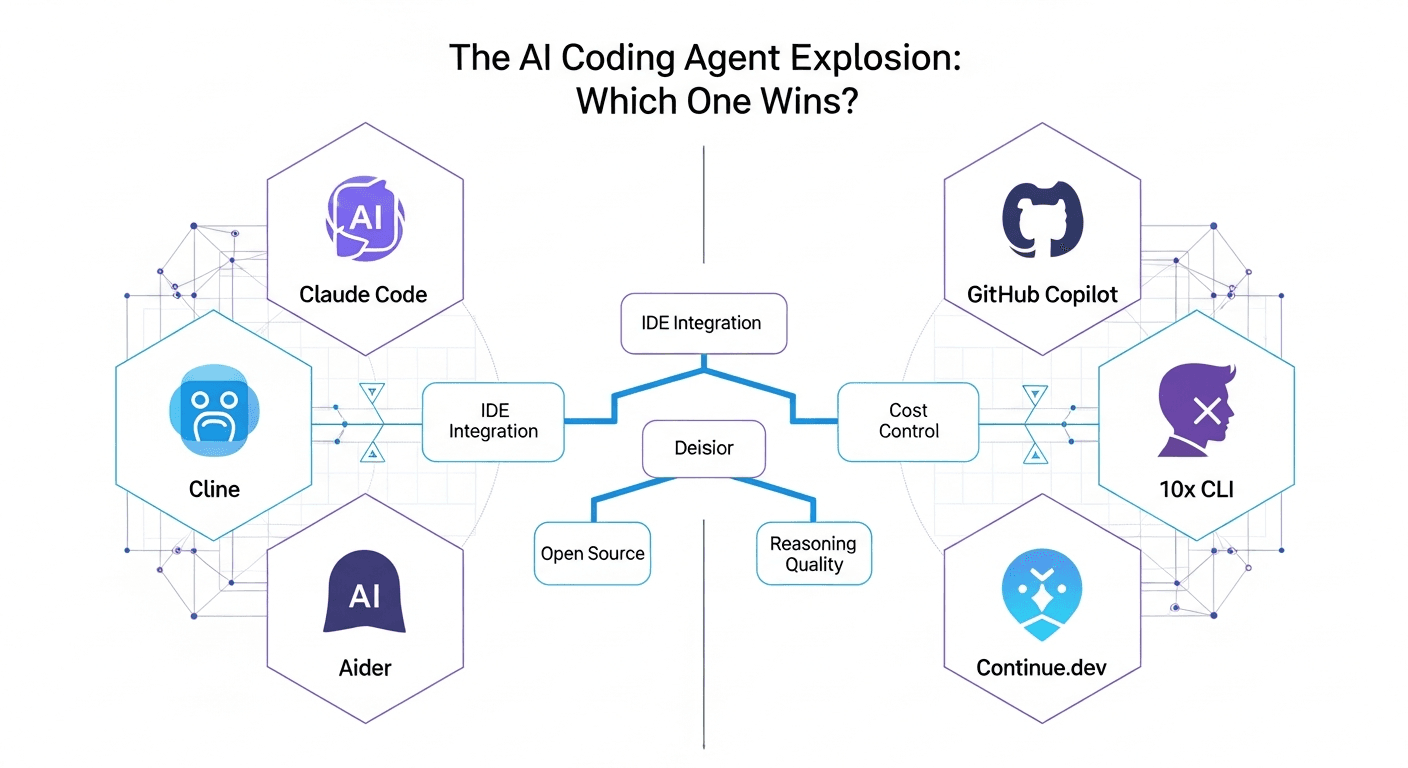
The AI Coding Agent Explosion: Which Tool Wins in 2026?
For the past year, we’ve been sold a myth: one AI coding agent to rule them all.
GitHub Copilot. Or Cursor. Or Claude Code. Pick one, the story goes, and it will make you 10x faster.
But in early 2026, that narrative has collapsed. The market has fractured into seven distinct approaches, each winning in different contexts. And the most interesting innovation isn’t coming from the big names—it’s coming from a 1,400-star GitHub project that solved a problem nobody else bothered to address: How do we make model routing a visible, controllable decision instead of hiding it?
This is the story of how AI coding agents actually work, why they’re all slightly wrong for you, and what’s actually worth your time.
The Death of “One Tool to Rule Them All”
Cursor raised $29.3 billion at Series D. GitHub Copilot is integrated into every major IDE. Claude Code powers the most sophisticated reasoning in the market.
But none of them have solved the fundamental problem: different tasks need different models.

Writing boilerplate code? You don’t need Claude Opus 4.5. You need something fast and cheap.
Debugging a complex race condition in a distributed system? You need the best model available.
Refactoring an API? You need something in the middle—good enough for code generation, fast enough to not waste money.
Previous generations pretended this didn’t matter. They either:
- Locked you into one model family (Claude Code: Anthropic only)
- Made routing automatic and invisible (GitHub Copilot, Cursor)
- Gave you a model picker but no guidance (pick per-session, hope for the best)
All of these are suboptimal. They either waste money or lose quality. Usually both.
Enter 10x CLI: The Routing Revolution
In 2025, a project called 10x CLI (1,400 GitHub stars) did something radical: it made model routing a first-class concern.
Instead of hiding routing decisions in opaque logic, 10x makes it explicit in YAML:
---
name: refactor-api
trigger: /refactor-api
---

## Step 1: Analyze (model: superfast)
Read the current API implementation and list all endpoints.

## Step 2: Plan (model: smart)
Based on {{previous}}, design a refactored architecture.

## Step 3: Implement (model: fast)
Implement the new API based on the plan from step 2.
Each step declares which model tier it needs:
- Superfast (⚡⚡): GPT OSS 20B — $0.08 per million tokens, 564 tokens/sec
- Fast (⚡): Kimi K2 1T (MoE) — $0.12 per million tokens, best code generation
- Smart (◆): Claude Opus 4 — $5+ per million tokens, complex reasoning
The result? 70% of workflow steps run on the cheapest tier. 30% on the smartest.
Effective cost: $1.85 per million tokens vs. $5+ for all-premium.
That’s a 63% cost reduction while maintaining better quality than using a single model for everything.


The Math That Changes Everything
Research from Requesty confirms this isn’t theoretical:
Tasks that need cheap models:
- Documentation generation
- Test suite scaffolding
- Boilerplate code
- Code explanation
- PR description writing
Tasks that need expensive models:
- Novel architecture design
- Complex debugging
- Security vulnerability analysis
- Cross-cutting system changes
Organizations implementing routing report:
- 30-70% cost reduction while maintaining quality
- 0% quality regression when routing decisions are correct
- Faster iteration because cheap models are 20x faster
The insight: You don’t need the best model for everything. You need the right model per task.
Why Didn’t Anyone Else Do This?
Here’s the uncomfortable truth: the commercial AI coding agent market optimizes for subscription revenue, not user outcomes.
Cursor ($20-40/month): If you let users route to cheaper models, they use fewer tokens. Lower LLM costs for Cursor. Less subscription revenue needed. Bad business.
GitHub Copilot ($10-19/month): Same problem. Routing to cheaper models means fewer API calls to OpenAI. Less revenue sharing.
Claude Code: Locked into Anthropic models for strategic reasons. Routing to GPT OSS or Kimi K2 would cannibalize Anthropic’s business.
Only open-source projects (10x, Aider, Cline) and platforms that don’t own a model vendor (Continue.dev) can implement honest routing.
This is the classic misaligned incentives problem: the business model of subscription SaaS directly conflicts with user economics.
So What’s Actually Good in 2026?

Here’s the honest breakdown:
Cursor ($20-40/month)
Best for: Professional developers on large codebases needing IDE integration
- Full VS Code fork with native multi-file reasoning
- Composer mode edits all related files simultaneously
- Multi-agent on git worktrees (parallel refactoring + testing + docs)
- 4.9/5 user ratings—highest in category
- You’re paying for IDE integration and convenience, not necessarily the best routing
Claude Code (Included with Claude Pro)
Best for: Terminal developers wanting the smartest model
- SWE-Bench leader: Claude Opus 4.5 at 45.89% accuracy
- Best reasoning for novel problems
- Disciplined single-threaded loop (no agent chaos)
- Model-locked to Anthropic (strategic choice)
Cline (Free, 58k stars)
Best for: Cost-conscious developers wanting control
- Model-agnostic: any OpenAI, Anthropic, Google, local Ollama
- 5M VS Code installs—most-validated open-source agent
- Plan/Act dual-mode (read-only before execution)
- Per-session cost tracking
- Every file edit requires human approval
Aider (Free, 30k stars)
Best for: Terminal developers with Git workflows
- Native git integration (auto-commits with meaningful messages)
- Architect mode for planning before implementation
- Repository map (efficient context without all tokens)
- Best with Claude Sonnet or DeepSeek R1
10x CLI (Free, 1.4k stars)
Best for: Developers writing custom workflows with routing
- Explicit per-step model routing
- Custom “Superpowers” in YAML
- BYOK via OpenRouter (500+ models)
- MIT licensed, fully open-source
- Smallest community, but most innovative approach
GitHub Copilot (IDE + Async Agent)
Best for: GitHub-native teams wanting issue automation
- Dual-track: IDE agent (synchronous) + Coding Agent (async for issues)
- Native GitHub integration (creates PRs automatically)
- SOC 2 compliance for enterprise
- Fully managed, zero setup required
obra/superpowers (37k stars, Framework)
Best for: Teams wanting mandatory TDD and structured phases
- Not a tool but a methodology layer (installs on Claude Code, Cursor, Cline)
- Seven-phase mandatory workflow: Brainstorm → Plan → Test-Driven Development → Review
- Prevents agents from skipping steps when overconfident
- Most-validated workflow framework in the category
The Uncomfortable Truth: No Single Winner
There’s no “best” AI coding agent in 2026.
- Cursor wins on IDE integration and user ratings
- Claude Code wins on reasoning quality (SWE-Bench 45.89%)
- Cline wins on open-source validation (58k stars)
- Aider wins on Git integration
- 10x CLI wins on cost efficiency
- GitHub Copilot wins on GitHub native workflows
- obra/superpowers wins on methodology enforcement
You have to choose what matters most to you:
| You Want | Choose |
|---|---|
| Best reasoning for novel problems | Claude Code |
| Best IDE integration + multi-file refactoring | Cursor |
| Maximum flexibility + open-source | Cline |
| Native Git integration | Aider |
| Cost-optimized routing | 10x CLI |
| GitHub automation | GitHub Copilot |
| Mandatory TDD enforcement | obra/superpowers (layer) |
The Prediction: Routing Becomes Standard

By late 2026, intelligent per-step model routing will be table stakes. Every major agent will expose:
- Model picking (choose per task)
- Task complexity scoring (automatic tier detection)
- Cost attribution (show cost per step)
- Custom routing rules (define your own thresholds)
The agents that get routing right will dominate. The ones that ignore it will become purely enterprise lock-in plays (GitHub Copilot, Cursor) for teams that don’t care about cost.


What You Should Do
If You’re Building Developer Tools
Learn from 10x CLI’s approach. Exposed routing is better than hidden routing, even if you don’t implement it perfectly.
If You’re Choosing an AI Coding Agent
- Start with whatever integrates best into your workflow (IDE vs. terminal)
- Pick a tool whose business model aligns with your cost optimization (open-source > subscription)
- Monitor routing transparency—tools that hide cost decisions are not optimizing for you
- Consider obra/superpowers as a methodology layer on top of your chosen tool
If You’re Building Agents for Users (Like Augmi)
The per-step routing pattern from 10x is directly applicable. Your users deploying OpenClaw agents would benefit from choosing cheaper models for reconnaissance steps and expensive models only for reasoning. Expose this choice, and you’ll see adoption increase.
The Bottom Line
The AI coding agent market in 2026 is not consolidating—it’s specializing. The “winner” is not the one with the most stars or the highest valuation. It’s the one that’s honest about tradeoffs and doesn’t hide important decisions behind subscription pricing.
The most interesting innovation isn’t coming from Cursor or GitHub or Anthropic. It’s coming from a 1,400-star project that nobody’s heard of, which figured out that visible, auditable, controllable routing is better than black-box optimization.
And that might be the most important lesson for the entire AI industry.
Want to dig deeper? See our full technical analysis of all seven approaches, cost economics, and benchmarking data in the accompanying research document.