A thousand people stood in line outside Tencent’s Shenzhen headquarters last week. They weren’t there for a product launch, a job fair, or a free phone. They were there to get an open-source AI agent installed on their laptops.
Appointment slots ran out within an hour. Tencent cloud engineers were on-site helping retirees, students, and office workers get set up. Red lobster plush toys were handed out like swag at a developer conference, except most of the people in that line had never been to a developer conference in their lives.
Welcome to the “raise a lobster” era.
What happened in China
OpenClaw, the autonomous AI agent framework built by Austrian developer Peter Steinberger, hit 302,000 GitHub stars in roughly 90 days. Linux took 30 years to reach 250,000. Nearly half of all publicly tracked OpenClaw deployments came from China.
But the GitHub numbers barely scratch the surface.
The Chinese internet coined a phrase for installing and running OpenClaw: “raise a lobster” (a reference to the project’s red lobster mascot). The phrase spread across Weibo, Bilibili, WeChat groups, and Xiaohongshu. Tutorial videos, “lobster farm” screenshots (clusters of running agents), and memes about raising your agent like a pet flooded every platform.
Then the meetups started. Baidu hosted hundreds at their Beijing HQ. Self-organized community gatherings drew 500+ people across Shanghai and Shenzhen. One event on March 7 pulled over a thousand attendees, standing room only.
The demographics weren’t what you’d expect. Retired aerospace engineers. Homemakers. Small business owners. Students. Office workers. This wasn’t an early-adopter tech crowd. This was everyone.
Every major tech company scrambled
ByteDance launched ArkClaw on March 9, a browser-based, zero-setup cloud version integrating their own Doubao model along with Kimi 2.5 and MiniMax 2.5. Alibaba shipped JVS Claw as a mobile app (iOS and Android) letting non-coders deploy agents in minutes, wired into Taobao and Alipay. Baidu launched DuClaw. Tencent offered one-click deployment through Tencent Cloud.
Four of China’s biggest tech companies all launched their own versions of the same open-source project within the same month. If that isn’t the clearest market signal of 2026, I don’t know what is.
The stock market noticed. MiniMax surged 27.4% over a single weekend and hit a $44 billion valuation, despite generating only $79 million in revenue the prior year. For a brief moment, MiniMax’s market cap exceeded Baidu’s. Baidu had $18.5 billion in revenue. That ratio is hard to process.
The government paradox
China’s government banned OpenClaw from state office computers, state-owned enterprises, and state banks. Military families were restricted from using it on personal phones connected to work networks. The national vulnerability database issued two separate security warnings about improperly configured deployments.
And in the very same week, Shenzhen’s Longgang District proposed subsidies of up to 2 million yuan ($289,000) specifically for OpenClaw app development. Wuxi offered 1-5 million yuan for industrial OpenClaw applications. Premier Li Qiang’s Government Work Report, delivered at the National People’s Congress, explicitly called for “large-scale commercial application” of AI agents for the first time in history.
Ban it from government offices. Subsidize it for commercial development. Both at the same time.
That tension isn’t unique to China. Every government in the world is about to face the same fork. AI agents are coming regardless.
The “one-person company” is real now
The phrase that kept surfacing alongside the lobster craze was “one-person company,” the idea that a single individual can run AI agents as virtual staff handling emails, research, scheduling, client work, and operations.
This concept went viral during China’s Two Sessions political discussions. NPC deputy Zhou Hongyi, founder of 360 Security Group, publicly called OpenClaw “extremely easy to operate.” Designers described their agents as “virtual staff” that reduced their workload. Entrepreneurs on Alibaba’s Xianyu platform started charging 299 yuan ($44) just to help people install it.
A paid install market. For open-source software. That tells you everything about the demand curve.
Why this matters if you’re building in this space
The thing that unlocked mass adoption wasn’t a better model or a fancier UI. It was removing friction from deployment.
Every Chinese tech giant’s response was the same: build an easier way to deploy. Browser-based. Mobile app. One-click cloud. The company that wins the agent layer will be the one that removes the most setup complexity.
Chinese cloud providers had a $60 billion infrastructure incentive to push this. A single OpenClaw instance consumes 10-100x more tokens per day than a chatbot session. One documented user was spending $20/day on API calls from background agent polling alone. Every deployed agent is a recurring revenue engine.
But the demand was real and organic. People weren’t being tricked into adopting agents. They were lining up for them. Literally.
What we’re building at Augmi
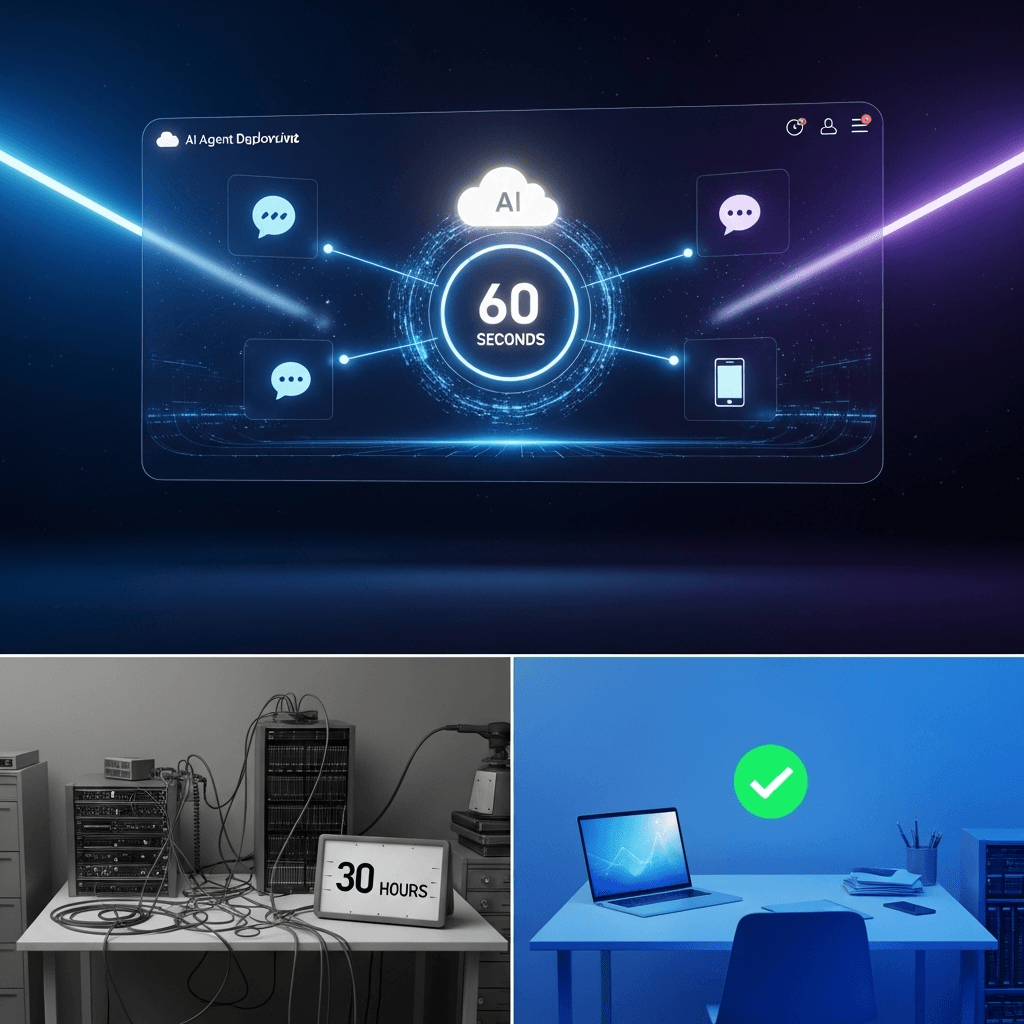
This is exactly the thesis behind Augmi. One-click agent deployment. No terminal, no Docker, no server provisioning. Pick your agent, configure it, click deploy, and it’s running on dedicated infrastructure with persistent state and channel integrations built in.
China just ran the experiment at national scale and proved the hypothesis: when you remove the friction between “I want an AI agent” and “I have an AI agent running,” adoption doesn’t grow linearly. It explodes.
We’re building the infrastructure for the one-person company era. Crypto-native payments, agent-owned wallets, and a deployment experience that anyone can use, not just developers.
Ready to deploy your first AI agent? Get started at augmi.world.