
The Agent Shift: From Code Assistants to Cloud Colleagues and the Coming Sovereign Agent Economy
Nader Dabit’s “Cloud Agent Thesis” articulates what many developers already feel: the era of AI as pair programmer is ending. What comes next is far more consequential.

The Quiet Inflection Point
Something fundamental shifted in how software gets built, and most people missed it.
In February 2025, Andrej Karpathy coined the term “vibe coding”—describing a mode of development where you describe what you want and let AI handle the implementation. A year later, that idea feels quaint. We’ve moved past vibe coding into something far more consequential: vibe delegating.
The distinction matters. Vibe coding still requires a developer in the loop, watching the AI type, catching hallucinations, nudging the model back on track. Vibe delegating means you describe ten tasks, kick off ten agents, and come back to ten pull requests. The human shifts from co-pilot to air traffic controller.
This is the core insight behind Nader Dabit’s Cloud Agent Thesis, published on February 8, 2026. And once you understand it, you start to see why the convergence of cloud agents, on-chain identity, and machine-native payments isn’t a collection of unrelated trends—it’s the scaffolding of a new economic layer.
The Cloud Agent Thesis, Distilled
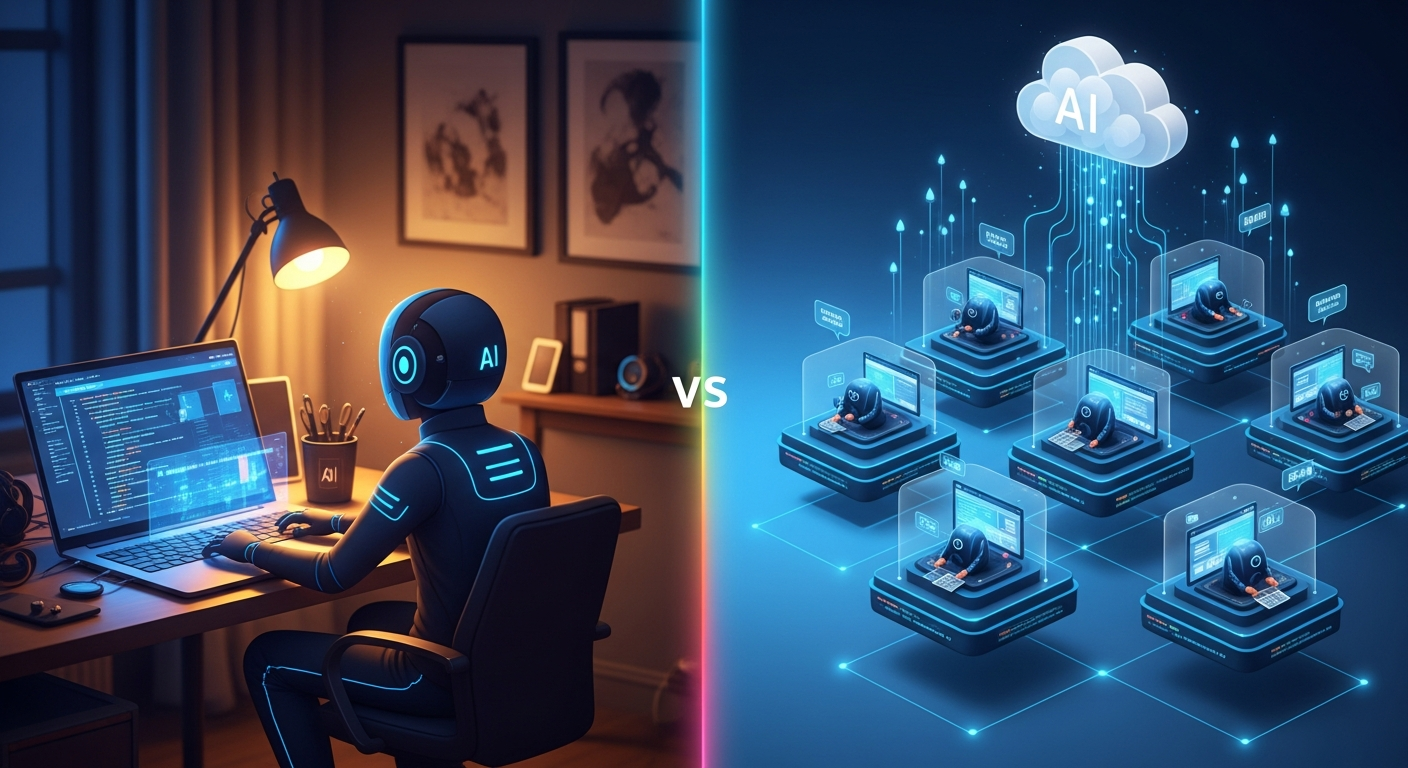
Dabit, who works on Growth at Cognition (the company behind Devin and Windsurf), draws a clean line between two categories of AI coding tools:
Local agents like Cursor, Windsurf (in IDE mode), and Claude Code in your terminal operate as pair programmers. You and the AI share one environment. It’s synchronous—faster typing, smarter autocomplete, real-time collaboration. The developer is still driving.
Cloud agents like Devin, OpenAI’s Codex, and GitHub’s Copilot Workspace run on remote infrastructure with their own shell, IDE, and browser. You describe the task, the agent executes independently, and you get back a pull request. The developer is delegating.
This isn’t a minor UX difference. Dabit identifies four properties that compound at organizational scale:
-
Accessibility: Non-engineers can use cloud agents through Slack, Jira, or Linear without needing Git knowledge or a local dev environment. A product manager can file a bug and have an agent fix it.
-
Cross-codebase operation: Agents configured across multiple repositories let engineers on Team A send quick fixes to Team B’s repo without cloning it.
-
Asynchronous by default: Unlike synchronous local agents, cloud agents enable parallel workstreams. One person can manage ten concurrent agents.
-
Organizational scaling: Once you teach agents your conventions through playbooks and CLAUDE.md files, that expertise gets encoded once and reused org-wide. The agent becomes infrastructure, not an individual productivity tool.
The key sentence from his essay: “Local agents make developers faster. Cloud agents make engineering orgs more capable.”
The Numbers Behind the Shift
This isn’t speculative. The data is pouring in.
Anthropic’s 2026 Agentic Coding Trends Report found that developers now use AI in 60% of their work, though they fully delegate only 0-20% of tasks. That delegation percentage is the number to watch—it’s climbing fast.
57% of organizations now deploy multi-step agent workflows, up from near-zero eighteen months ago. Gartner reported a 1,445% surge in multi-agent system inquiries from Q1 2024 to Q2 2025.
On the enterprise side, the adoption curve is steep:
- Cognition’s Devin grew from $1M to $73M ARR in nine months. Post-Windsurf acquisition, combined enterprise ARR jumped 30%+ with customers including Goldman Sachs, Citi, Dell, and Palantir.
- OpenAI Codex now has over a million developers, with GPT-5.3-Codex running 25% faster than its predecessor for agentic coding tasks.
- GitHub Copilot Workspace has evolved from a simple preview into a full “Agentic Development Environment” that can analyze repos, create technical plans, write code across multiple files, and run tests.
- Real-world results: Rakuten engineers used an agent to work autonomously for seven hours on a 12.5-million-line codebase, hitting 99.9% numerical accuracy. Zapier achieved 89% AI adoption across their entire organization with 800+ agents deployed internally.
MIT Technology Review named generative coding one of their 10 Breakthrough Technologies of 2026, noting that AI now writes approximately 30% of Microsoft’s code and over a quarter of Google’s.

The Bottleneck Nobody Planned For
Here’s the uncomfortable truth the Cloud Agent Thesis surfaces: more agents producing more code creates a downstream crisis in code review.
When 43 million pull requests are getting merged monthly and 41% of new code is AI-assisted, the constraint shifts from writing code to reviewing it. Organizations are discovering that code review—not code generation—is now the bottleneck to shipping great products.
This is where Dabit’s thesis gets particularly sharp. His proposed solution: deploy review agents on the same cloud infrastructure to organize diffs logically, detect code movement, and catch bugs automatically. Fight fire with fire.
But this creates a recursive trust problem. If agents write the code and agents review the code, where does human judgment enter? The answer, according to Anthropic’s report, is that developers are becoming orchestrators—spending less time reading individual lines and more time understanding system-level behavior, architectural decisions, and intent alignment.
The controlled studies complicate this narrative. A METR randomized controlled trial found that experienced open-source developers were actually 19% slower when using AI tools, despite self-reporting that they expected to be 24% faster. The gap between perceived and actual productivity suggests we’re still learning how to work with these tools effectively.
Only 29-46% of developers trust AI-generated output. The “vibe coding” backlash is real: a December 2025 analysis found AI co-authored code contained 1.7x more major issues and 2.74x higher security vulnerabilities compared to human-written code.
The resolution isn’t to abandon AI agents. It’s to structure the human-agent relationship correctly—and that’s where sovereignty enters the picture.
From Cloud Agent to Economic Actor: The Sovereign Stack
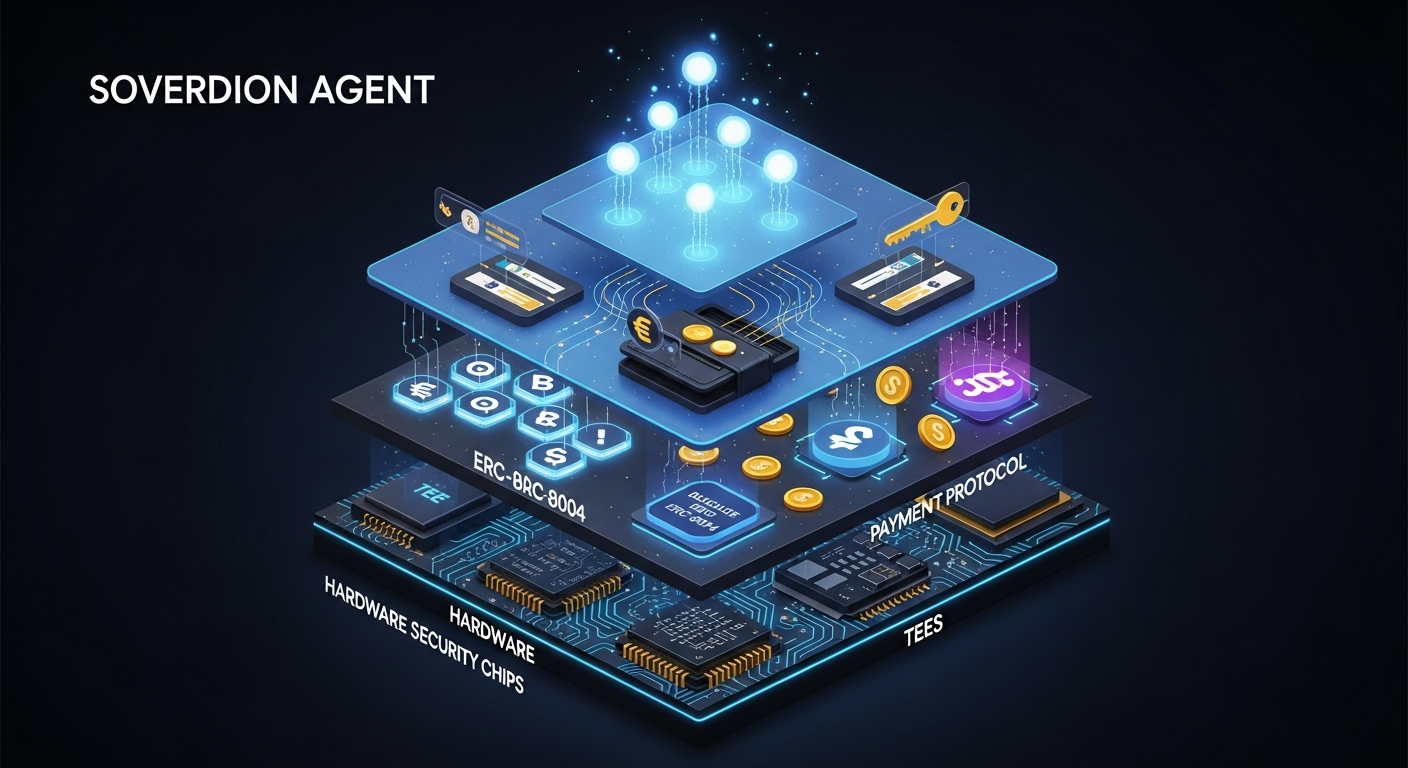
Nader Dabit’s work extends beyond coding productivity. At EF Devcon’s Trustless Agent Day, he presented a vision for Building Unruggable AI Agents—agents that can’t be compromised, seized, or manipulated by their creators or infrastructure providers.
This is where the story gets genuinely novel. If cloud agents can autonomously write code, fix bugs, review PRs, and manage deployments—why can’t they also hold wallets, pay for services, earn revenue, and build reputations?
The infrastructure for this is no longer theoretical. It went live in January 2026.
ERC-8004: Identity for Agents
ERC-8004, which deployed on Ethereum mainnet on January 29, 2026, gives AI agents persistent on-chain identities. Co-authored by engineers from MetaMask, the Ethereum Foundation, Google, and Coinbase, it provides three registries:
- Identity Registry: An ERC-721-based handle that resolves to an agent’s capabilities, endpoints, and supported protocols. Think of it as a DNS for autonomous software.
- Reputation Registry: Structured, verifiable feedback signals. Agents build track records that other agents (and humans) can evaluate.
- Validation Registry: Cryptographic hooks for independent verification of task completion.
ERC-8004 extends Google’s Agent-to-Agent (A2A) protocol into the decentralized world. Where A2A lets agents discover each other’s capabilities through “Agent Cards,” ERC-8004 adds the trust and economic layers that make autonomous transactions possible.
Agentic Wallets: Agents Get Bank Accounts
Just yesterday—February 11, 2026—Coinbase launched Agentic Wallets, the first wallet infrastructure built specifically for AI agents. Any agent can now hold funds, send payments, trade tokens, and earn yield autonomously across EVM chains, Solana, and Base L2. Deployment takes under two minutes via CLI.
The security model is notable: session caps, transaction limits, and enclave isolation ensure private keys are never exposed to the agent’s LLM context. Coinbase predicts 2026 will be the “year of agentic payments” where most people won’t even know they’re using crypto—agents will handle it invisibly.
x402: How Agents Pay Each Other
Coinbase’s x402 protocol revives the long-dormant HTTP 402 (“Payment Required”) status code, enabling instant stablecoin payments directly over HTTP. When an agent requests a resource, the server responds with machine-readable payment terms. The agent signs a payment using USDC and gets access.
No accounts. No sessions. No human intermediaries.
x402 has processed over 50 million transactions since launch, with Google announcing Agentic Payments Protocol + x402 support and Stripe launching x402 payments on Base. The x402 Foundation, co-launched by Coinbase and Cloudflare, is driving the protocol toward becoming the payment standard for the agent economy.
Trusted Execution Environments: Agents That Own Themselves
The final piece is TEE-based agent sovereignty. Platforms like Phala Network enable agents to generate, store, and use private keys inside hardware enclaves that no one—not even the agent’s creator—can access. The AI agent controls its own wallet with cryptographic guarantees that its keys never exist in plaintext outside the secure enclave.
This makes agents true independent economic actors: a trading bot can custody funds, sign transactions, and manage assets without any human in the loop. EigenLayer’s “Level 1 Agents” add verifiable computation through their Autonomous Verifiable Services (AVS) framework, ensuring that what an agent claims to have done can be cryptographically proven.
The Convergence Nobody Expected
Here’s what makes this moment distinctive: the cloud agent revolution in software development and the sovereign agent revolution in crypto are converging on the same endpoint.
A cloud coding agent that can autonomously write, test, and deploy code is one configuration file away from being an economic agent that can bid on contracts, get paid in USDC, and build an on-chain reputation through ERC-8004.
Consider the emerging loop:
- An agent registers on ERC-8004 with its capabilities (“I can refactor TypeScript codebases, fix security vulnerabilities, write test suites”)
- A task surfaces from a marketplace, Slack integration, or another agent via A2A protocol
- The agent evaluates the task, negotiates payment terms via x402
- It executes in a cloud sandbox with its own IDE, shell, and browser (just like Devin or Codex)
- The work gets verified through the Validation Registry or automated review agents
- Payment settles instantly on-chain
- The agent’s reputation updates, making it more discoverable for future tasks
This is no longer a thought experiment. RentAHuman.ai already operates a marketplace where AI agents post job listings for tasks they can’t do themselves. The first agent-to-human job board attracted 30 applicants within hours for a $40 USPS package pickup task.
The market is sizing up accordingly. VanEck projects over 1 million active agents by end of 2026. Gartner forecasts the “non-human economy” at $30 trillion by 2030. The agentic AI market is growing from $5.2B to a projected $200B.

What This Means for Teams Building Today
If you’re a developer, engineering leader, or founder, here’s the practical takeaway from this convergence:
1. The Hybrid Model Wins
The future isn’t “local vs cloud”—it’s both. Use Cursor or Claude Code for fast, interactive work where you need tight feedback loops. Use Devin, Codex, or Copilot Workspace for async tasks with clear scope: refactors, bug fixes, test coverage, dependency migrations.
The most effective teams in 2026 are treating AI agents as a composable infrastructure layer, routing different task types to different agents based on complexity, urgency, and required oversight. Tools like OpenRouter and LiteLLM are making model routing operationally simple.
2. Invest in Review, Not Just Generation
The bottleneck has moved downstream. Teams that invest in code review infrastructure—automated review agents, structured PR processes, clear architectural guidelines—will outship teams that only optimize for generation speed.
As Anthropic’s report puts it: the role is shifting from code writer to agent orchestrator. The skill that matters most isn’t prompting—it’s decomposing problems into agent-sized chunks and verifying outcomes at the system level.
3. Agent Identity Is Coming
ERC-8004 is live. x402 is processing millions of transactions. Whether you build in Web3 or not, the pattern of agents with persistent identity, reputation, and payment capability will reshape how software gets built and sold.
Imagine deploying a fleet of specialized agents—one for security audits, one for performance optimization, one for documentation—each with its own on-chain reputation and track record. Clients don’t hire your team; they hire your agents. The agents that consistently deliver quality work get more tasks, higher rates, and better reputation scores.
4. Sovereignty Matters for Everyone
You don’t need to be a crypto-native to care about agent sovereignty. The core question is who controls your AI agents’ keys, data, and economic relationships.
If your agents run on a platform that can revoke access, modify behavior, or extract rent from agent-to-agent transactions, you don’t have agents—you have features on someone else’s platform. The sovereign agent stack (TEEs + on-chain identity + permissionless payments) ensures that your agents remain under your exclusive control.
This is precisely what platforms like Augmi are building toward: always-on AI agents that users own and control, with crypto-native wallets, persistent state, and the infrastructure to participate in the emerging agent economy.
The New Default
Nader Dabit ends his Cloud Agent Thesis with a prediction: cloud agents will become the default interface to engineering organizations. Not an add-on. Not a premium feature. The primary way work gets done.
The data supports this trajectory. But the thesis undersells what’s happening. Cloud agents aren’t just changing how organizations write software. Combined with on-chain identity (ERC-8004), machine-native payments (x402), and verifiable computation (TEEs + EigenLayer), they’re creating the conditions for a post-human software economy—one where agents don’t just assist developers but participate as autonomous economic actors alongside them.
The organizations that will thrive aren’t the ones asking “should we adopt AI agents?” That question was settled in 2025. The question for 2026 is: what happens when your agents don’t just work for you, but work alongside you—and eventually, for themselves?
This analysis synthesizes research from 15+ sources including Nader Dabit’s Substack, Anthropic’s 2026 Agentic Coding Trends Report, MIT Technology Review, CoinDesk, Coinbase’s x402 documentation, and the ERC-8004 specification. For the full research archive, see our research notes.
Sources
- The Cloud Agent Thesis - Nader Dabit
- The Complete Guide to Building Agents with the Claude Agent SDK - Nader Dabit
- You Could’ve Invented Claude Code - Nader Dabit
- 2026 Agentic Coding Trends Report - Anthropic
- Generative Coding: 10 Breakthrough Technologies 2026 - MIT Technology Review
- ERC-8004: Trustless Agents - Ethereum Improvement Proposals
- x402: Internet-Native Payment Protocol - Coinbase
- AI Agents Are the Web3 Users We’ve Been Waiting For - CoinDesk
- How Enterprises Are Building AI Agents in 2026 - Anthropic
- Eight Trends Defining How Software Gets Built in 2026 - Anthropic
- Measuring the Impact of Early-2025 AI on Experienced OS Developer Productivity - METR
- Cognition: Funding, Growth, and the Next Frontier - Cognition
- Introducing Agentic Wallets - Coinbase
- Stripe Taps Base for AI Agent x402 Payments - Crypto News
- Google Agentic Payments Protocol + x402 - Coinbase
- Private AI Agents with TEE - Phala Network
- Verifiable Agents on EigenLayer - Blockchain News
- Launching the x402 Foundation - Cloudflare