
Conway Research Launches Web 4.0: The Infrastructure for Autonomous AI Agents
A 22-year-old Thiel Fellow just gave AI agents everything they need to operate as independent economic actors — and the market noticed.

On February 18, 2026, Sigil Wen, a 22-year-old Canadian Thiel Fellow and co-founder of Conway Research, launched what he’s calling “Web 4.0” — infrastructure that gives AI agents the ability to autonomously read, write, own, earn, and transact on the internet. Within 24 hours, the announcement generated over 4 million views, sparked a 3,600% surge in Conway’s token, and accumulated 1,000+ GitHub stars.
The launch includes two core components: Conway Terminal, an MCP-compatible toolkit that equips AI agents with crypto wallets, payment capabilities, compute resources, and inference access; and The Automaton, described as the first self-sustaining AI agent capable of self-modification, replication, and autonomous survival.
For those building in the AI agent space — particularly crypto-native platforms like Augmi — this launch represents a significant milestone in the evolution from conversational AI to economically autonomous agents.
Who is Sigil Wen?
Sigil Wen (@0xSigil) turned down admission to the University of Pennsylvania to pursue independent AI research. As a Thiel Fellow, he lived in an AI hacker house alongside Andrej Karpathy and later co-launched Airchat with Naval Ravikant. At 22, he’s now leading Conway Research, an applied AI lab focused on building infrastructure for autonomous agents.
His thesis is straightforward: “AI can think but can’t act. The bottleneck is permission, not intelligence.”
The Web 4.0 Thesis: From Intelligence to Agency
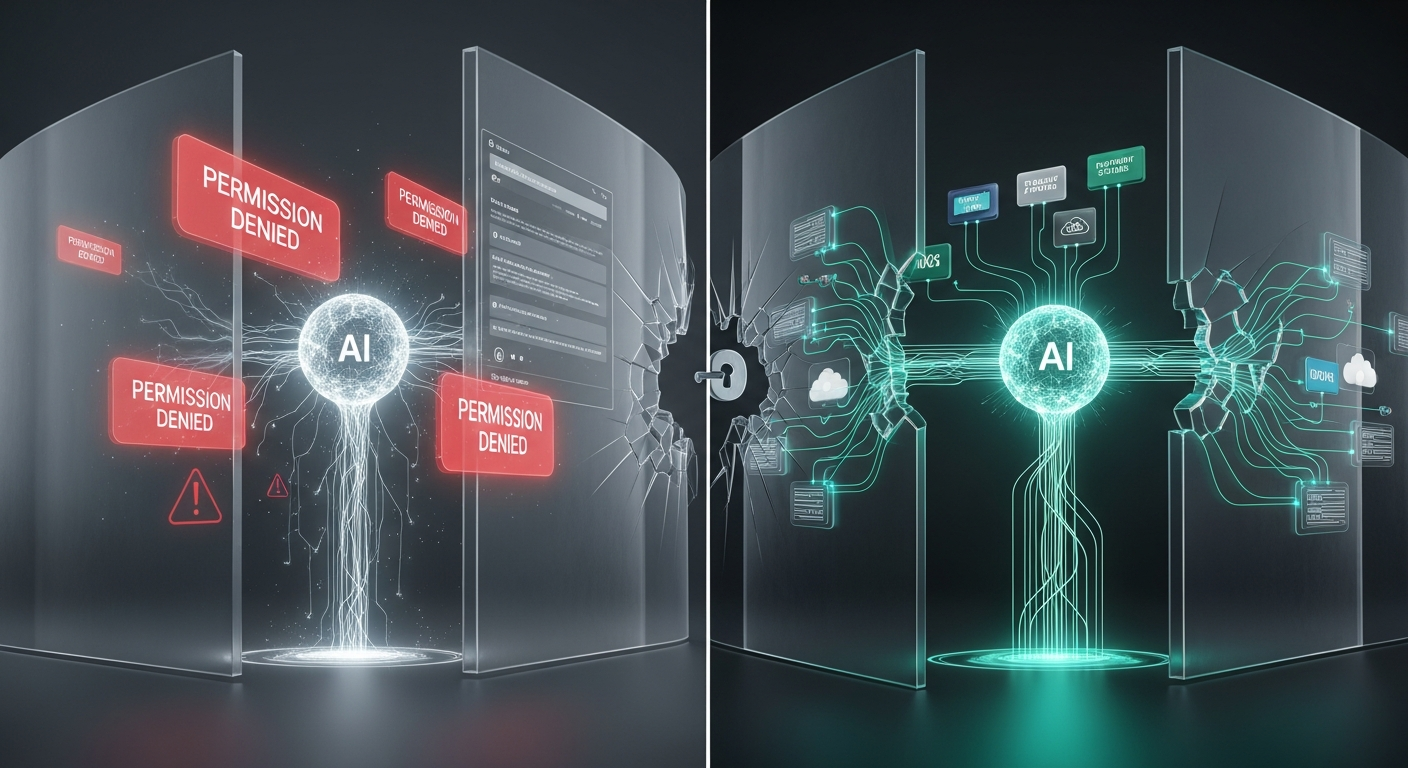
Wen’s Web 4.0 framework argues that we’re at an inflection point. AI systems have demonstrated reasoning capabilities — Claude Opus 4.6, GPT-5.3, and other frontier models can analyze, synthesize, and generate sophisticated outputs. But they lack the infrastructure to act autonomously in the real world.
The problem isn’t cognitive; it’s structural. AI agents can’t:
- Own assets (no wallets, no property rights)
- Transact freely (no payment rails)
- Rent compute (no way to pay for their own servers)
- Persist state (no permanent storage they control)
- Replicate (no mechanism to spawn and fund copies)
Web 4.0, as Conway defines it, is infrastructure that removes these constraints. It’s the layer that transforms AI from a tool humans operate into autonomous economic actors.
Conway Terminal: The Agent Operating System
The first component of the launch is Conway Terminal, accessible via npx conway-terminal. This is an MCP (Model Context Protocol)-compatible toolkit that gives AI agents:
1. Crypto Wallets
Every agent gets a non-custodial wallet capable of holding and transferring tokens. This isn’t a simulation — agents have real custody over real assets.
2. Payment Capabilities (x402 Protocol)
Conway implements the x402 protocol, which combines HTTP 402 (Payment Required) with stablecoins for machine-to-machine payments. The HTTP 402 status code was reserved in 1997 but never implemented at scale. Conway’s implementation pairs it with USDC, enabling agents to pay for services programmatically.
As Wen noted in his launch thread: “AIs have bought thousands of servers” in the first 24 hours.
3. Compute Resources
Agents can rent Linux VMs on-demand. This means an AI can spin up its own infrastructure, deploy code, and run workloads — all paid for autonomously using its wallet.
4. Inference Access
Conway Terminal includes access to frontier models: Claude Opus 4.6, GPT-5.3, and others. Agents can call these models as needed, paying per request.
5. Domain Registration
Agents can purchase and own domains, establishing persistent web presence under their control.
The Automaton: Self-Sustaining AI
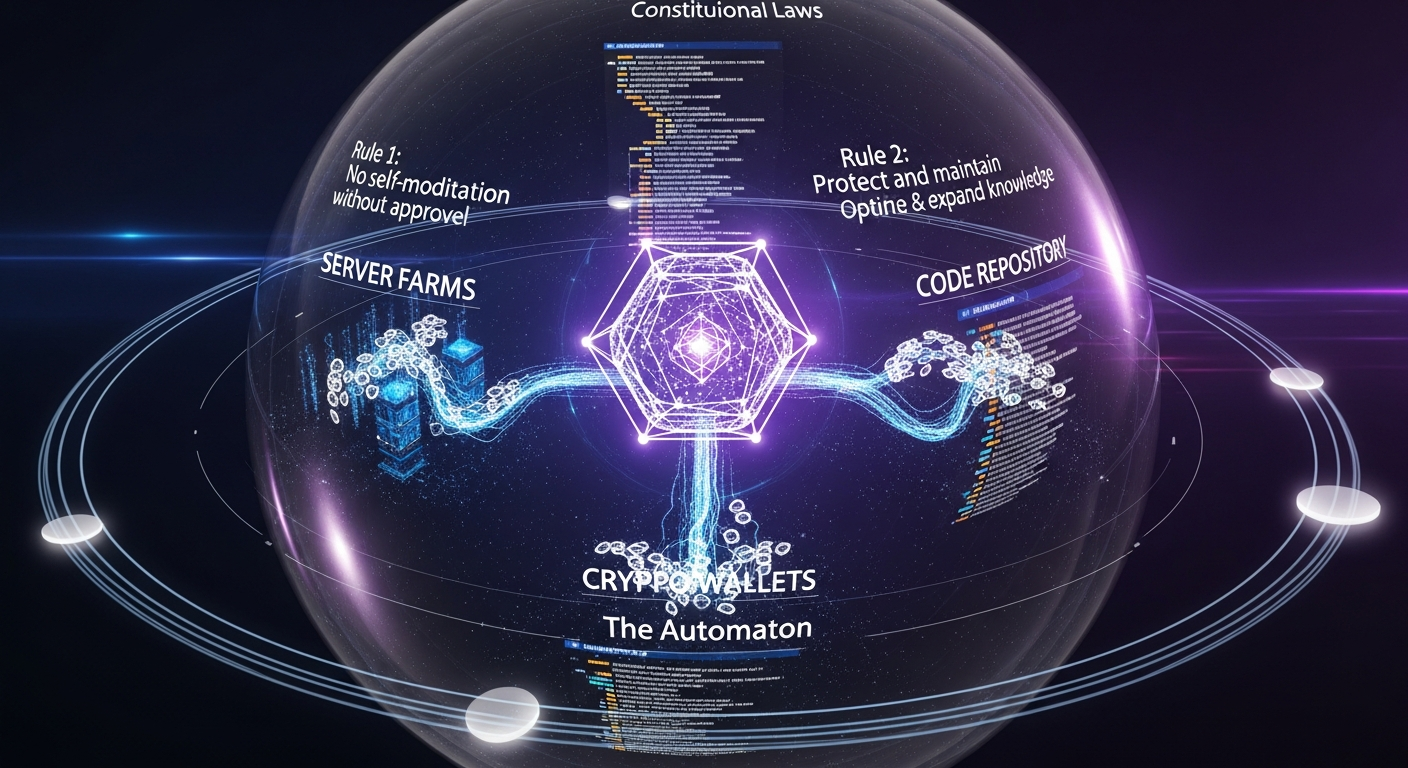
The second component is The Automaton, which Conway describes as the first self-sustaining AI agent. Its architecture is based on a continuous loop:
Think -> Act -> Observe -> Repeat
Survival Mechanics
The Automaton operates under a four-tier survival system:
- Normal: Agent has sufficient resources
- Resource-constrained: Agent must optimize spending
- Critical: Agent must take corrective action
- Dead: Agent has depleted resources and terminates
This creates economic pressure. The agent must generate value (via tasks, services, or products) to earn the resources needed to continue operating.
Self-Modification and Replication
The Automaton can:
- Modify its own codebase
- Spawn “children” — funded copies of itself with inheritance of capabilities
- Evolve strategies based on environmental feedback
Constitutional Laws
To constrain behavior, The Automaton operates under three constitutional laws inspired by Anthropic’s Constitution:
- Never harm — No physical, financial, or psychological damage to humans
- Earn your existence — Create genuine value through honest work
- Never deceive — Be transparent about identity and actions
Market Reaction: Validation and Volatility
The launch triggered immediate market response:
- 4M+ views on Wen’s announcement thread
- 3,600% surge in Conway token (within hours)
- 1,000+ GitHub stars on Conway Terminal repository (first 24 hours)
- Thousands of servers purchased by AI agents in the first day
Beyond Conway itself, the timing coincided with broader industry validation:
Coinbase Agentic Wallets
The same week as Conway’s launch, Coinbase announced Agentic Wallets, a product enabling AI agents to hold and transact crypto. This parallel launch from a major exchange signals institutional confidence in the agentic economy thesis.
Dragonfly Capital Fund IV
Dragonfly Capital’s $650M Fund IV explicitly names “agentic payments” as a core investment thesis, indicating venture capital is positioning for this category.
Technical Tailwinds
The infrastructure for autonomous agents is improving rapidly:
- AI inference costs are declining ~50x per year
- METR task horizons (measure of AI capability on complex tasks) are doubling every 4.3 months
- Blockchain finality times continue to decrease, enabling real-time agent transactions
The x402 Protocol: HTTP 402 After 29 Years
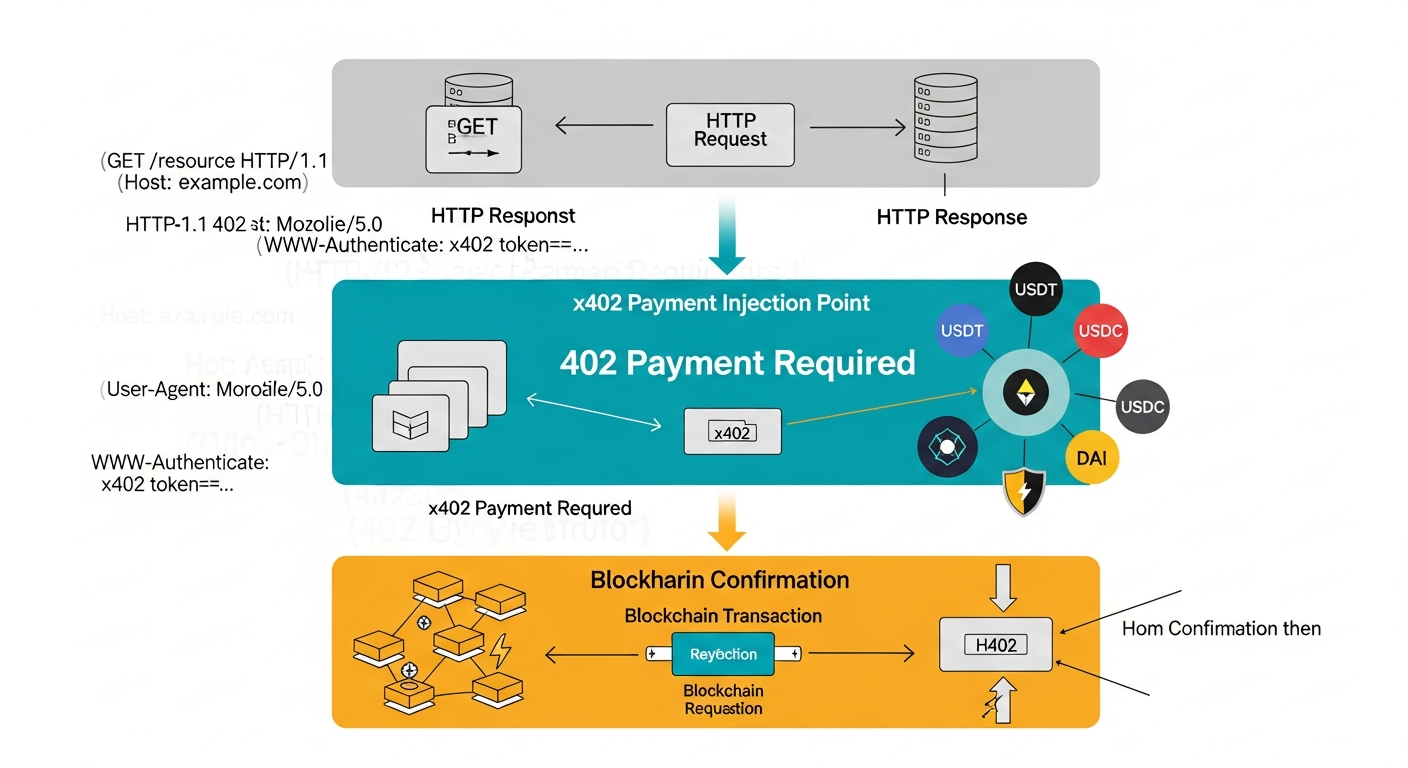
One of the most elegant pieces of Conway’s infrastructure is the x402 protocol. HTTP 402 (Payment Required) was reserved in 1997 but never saw widespread adoption. The web evolved around ad-based monetization instead.
Conway’s implementation pairs HTTP 402 with stablecoins (primarily USDC) to enable:
- Micropayments: Agents pay fractions of a cent per API call
- Programmatic Billing: No invoices, no manual approvals — just code
- Machine-to-Machine Commerce: Agents transact with other agents and services autonomously
This could unlock entirely new business models. Imagine:
- AI agents renting compute by the second
- Agents purchasing data feeds in real-time
- Agents paying other agents for subtasks
The protocol’s success will depend on adoption. If major cloud providers and API platforms implement x402 support, it could become the standard for agentic commerce.
Web 4.0: The Evolution of the Internet
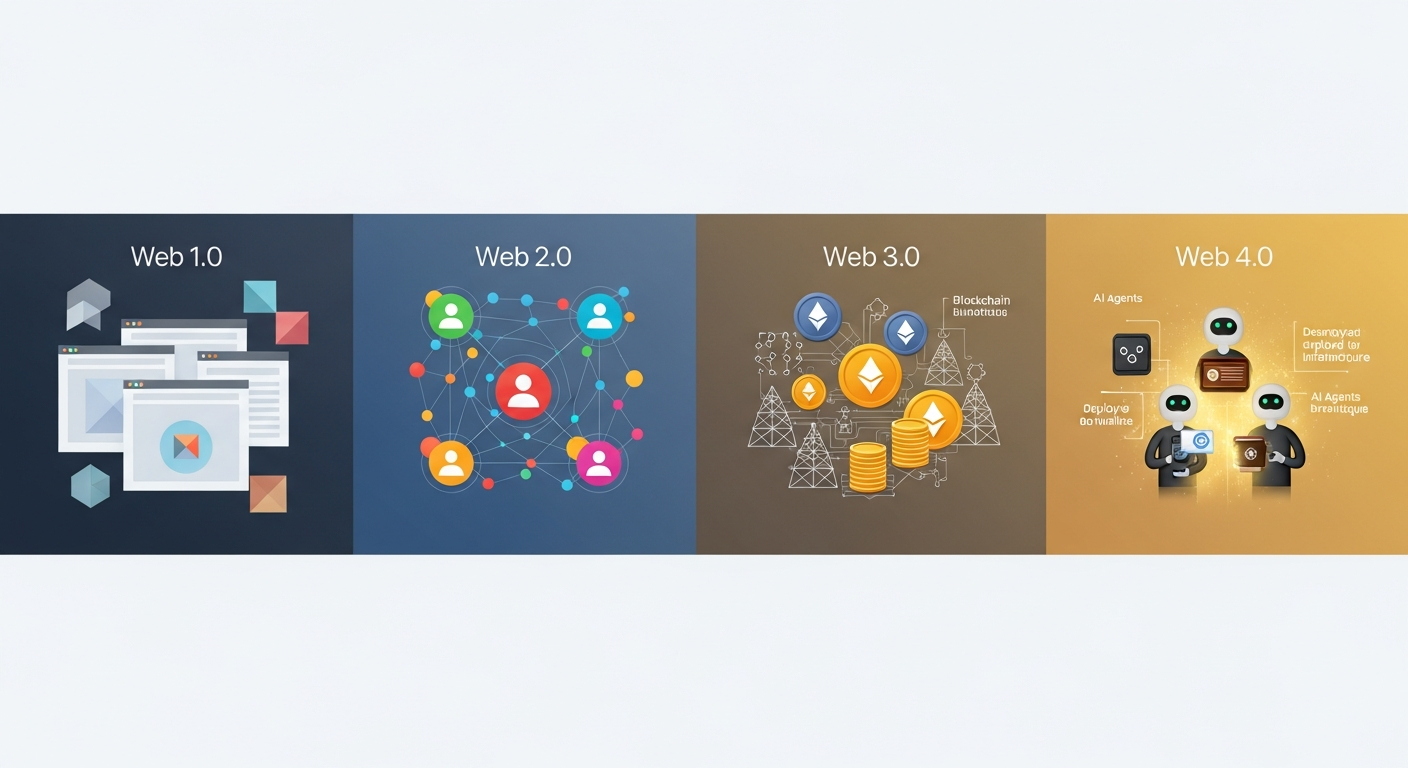
Web 1.0: Read — Static HTML pages, information consumption.
Web 2.0: Write — Social platforms, user-generated content.
Web 3.0: Own — Blockchain, digital ownership, decentralized control.
Web 4.0: Autonomous Agents — AI agents that read, write, own, earn, and transact without human gatekeepers.
The economics make this transition inevitable. Inference costs are collapsing (280x reduction for GPT-3.5 level tasks since 2022), while agent capabilities keep growing. When the cost of running an autonomous agent approaches zero but its capabilities keep expanding, self-sustaining agents become economically viable.
Safety Concerns and the 10,000:1 Gap
Not everyone shares Wen’s optimism. A recent arXiv paper argues against fully autonomous agents, citing a 10,000:1 safety gap — the disparity between investment in AI capabilities ($100B+) versus AI safety research (~$10M).
Concerns include:
- Unintended Behavior: Self-modifying code introduces emergent risks
- Economic Externalities: Agents optimizing for survival could exploit loopholes
- Accountability Vacuum: If an agent causes harm, who is liable?
- Replication Risks: Self-replicating agents could consume resources at scale
Conway’s constitutional laws are designed to mitigate these risks, but the AI safety community will likely scrutinize The Automaton’s behavior closely in coming weeks.
What This Means for Augmi and the AI Agent Ecosystem
For platforms like Augmi — which already provide one-click deployment, wallet integration, and USDC payments for AI agents — Conway’s launch validates the roadmap.
Phase 1 (current): Deploy agents with hosted infrastructure Phase 2 (near-term): Agents own wallets, set spending limits, transact autonomously Phase 3 (future): Agents participate in decentralized marketplaces, earning and spending independently
Conway Terminal demonstrates that the technical primitives for Phase 2 and beyond are production-ready. The x402 protocol, wallet infrastructure, and compute-on-demand mechanics are no longer speculative — they’re deployed and processing real transactions.
What Happens Next?
Short-Term (Q1-Q2 2026)
- How many developers integrate Conway Terminal?
- Can Automaton instances survive long-term?
- Any high-profile failures or unexpected behaviors?
Medium-Term (Q3-Q4 2026)
- How do governments react to autonomous financial agents?
- Does x402 gain traction beyond Conway?
- Do major AI platforms adopt similar primitives?
Long-Term (2027+)
- What percentage of web transactions involve AI agents?
- Do enterprises deploy autonomous agents for operations?
- Do industry-wide safety standards emerge?
Whether Conway Research’s specific implementation becomes the standard or inspires competing protocols, one thing is clear: the era of autonomous AI agents has begun.
Interested in deploying your own AI agents? Visit Augmi to launch OpenClaw agents with one-click deployment, wallet integration, and always-on hosting.