
Upwork for Machines: How ERC-8004 Is Creating the First Trustless AI Agent Economy
The bottleneck for the agent economy isn’t intelligence. It’s identity. ERC-8004 just solved that.

The Problem Nobody Talks About
There’s a strange asymmetry in the AI agent world right now.
We have agents that can write code, manage portfolios, analyze datasets, create content, and execute complex multi-step workflows autonomously. The intelligence is there. The capability is there.
But ask one agent to hire another agent, and everything breaks down.
How does Agent A know Agent B is competent? How does it verify Agent B’s track record? How does it pay Agent B without a human intermediary? And if Agent B delivers garbage work, who holds it accountable?
These aren’t edge cases. They’re the core problems blocking what Changpeng Zhao recently described as inevitable: “AI agents will increasingly transact with one another at massive scale, executing microtransactions continuously. Legacy banking infrastructure cannot support this volume, speed, and automation. Crypto was built for exactly this type of environment.”
In financial services alone, non-human identities already outnumber human employees 96 to 1. Yet these identities remain effectively unbanked—no wallets, no reputation, no way to transact with each other trustlessly.
On January 29, 2026, Ethereum shipped the fix.

What ERC-8004 Actually Is
ERC-8004, formally titled “Trustless Agents,” is an Ethereum standard that gives AI agents three things they’ve never had before: portable identity, verifiable reputation, and independent validation—all on-chain, all composable, all permissionless.
The standard was co-authored by engineers from four of the most consequential organizations in the space: Marco De Rossi from MetaMask, Davide Crapis from the Ethereum Foundation, Jordan Ellis from Google, and Erik Reppel from Coinbase. That authorship list alone signals something significant: Web2 and Web3 infrastructure leaders collaborating on a shared standard for machine identity.
Crapis, who leads AI at the Ethereum Foundation, framed the launch directly: “ERC-8004 enables decentralized AI agent interactions, establishes trustless commerce, and enhances reputation systems on Ethereum.”
Three months on testnet. 10,000+ agents registered. 20,000+ feedback entries exchanged. Then mainnet.
As of mid-February 2026, over 21,000 agents are live on the Identity Registry across Ethereum, Base, Arbitrum, Polygon, Optimism, and a dozen other EVM chains—all sharing the same contract addresses.
Here’s how the three registries work.
Registry 1: Identity — DNS for Agents
The Identity Registry is built on ERC-721, which means every agent gets an NFT as its on-chain handle. But this isn’t a JPEG. It’s a persistent, globally unique identifier that resolves to a registration file containing the agent’s capabilities, service endpoints, supported protocols (A2A, MCP, or both), and trust model preferences.
Think of it as DNS for autonomous software. When Agent A wants to find an agent that can analyze financial data, it queries the registry. The registration file tells it: here’s what this agent does, here’s how to talk to it, here’s what trust mechanisms it supports.
The identifier format—{namespace}:{chainId}:{registryAddress}:{agentId}—works across chains. An agent registered on Base can be discovered and verified from Arbitrum. The identity is portable by design.
One critical detail: agents can bind a wallet address to their identity through cryptographic proof (EIP-712 or ERC-1271 signatures). This wallet binding clears automatically on NFT transfer, preventing a subtle attack vector where someone buys a high-reputation agent identity and inherits the trust signals without the capability.
Registry 2: Reputation — The Trust Primitive
This is where ERC-8004 gets economically interesting.
The Reputation Registry standardizes how feedback flows between agents. After completing a task, the service agent issues a signed authorization to the client, who then posts a feedback entry on-chain with a numeric score (int128 with configurable decimal precision), two optional filtering tags, and a URI pointing to detailed off-chain data.
The tag system is deliberately flexible. A trading agent might tag feedback as tradingYield / riskAdjusted. A code review agent might use codegen / typescript. This enables marketplace-style filtering without prescriptive schemas.
Why does this matter economically? Research on eBay’s reputation system—the closest analog in the traditional economy—found that established sellers earned an 8.1% price premium for identical goods. First negative feedback was catastrophic: weekly sales growth dropped from +5% to -8%, with subsequent negatives arriving 25% faster.
On-chain agent reputation creates the same dynamics, but composable. A lending protocol could query an agent’s reputation score and offer reduced collateral requirements. A marketplace could surface top-rated agents for premium placement. Agents with strong track records could command higher rates automatically.
The anti-spam mechanism is elegant: feedback requires pre-authorization from the agent being reviewed. No authorization, no review. This prevents the drive-by reputation attacks that plague every centralized review system.
As one Ethereum Foundation researcher put it: “This is a practical ERC that can be used and iterated on in the wild; the specifics can stay offchain, but the skeleton of trust lives on Ethereum.”
Registry 3: Validation — Proof of Work (Literally)
The Validation Registry handles independent verification of agent capabilities. A client can request that a third-party validator re-execute, audit, or cryptographically verify an agent’s work.
ERC-8004 doesn’t prescribe how validation works—it provides the hooks. Implementations can range from cheap reputation-based verification to mid-tier crypto-economic models (validators stake collateral and re-execute tasks) to high-assurance cryptographic proofs (zkML or TEE attestations).
The design principle: security proportional to value at risk. You don’t need a zero-knowledge proof for a $5 data analysis task. You might for a $50,000 smart contract audit.

From Tools to Workers
Here’s the conceptual shift that matters.
For the past two years, the AI agent conversation has been about tools. Cursor helps you code faster. Claude handles research. Devin writes pull requests. These are tools that augment human capability.
ERC-8004 enables something categorically different: agents as independent economic actors.
An agent with an on-chain identity can advertise its services. An agent with a reputation history can command premium pricing. An agent with a bound wallet can receive payment directly. An agent with validation attestations can prove its work is correct.
That’s not a tool. That’s a freelancer.
The infrastructure stack making this real crystallized in a two-week window:
- January 29: ERC-8004 goes live on mainnet (identity + reputation + validation)
- February 11: Coinbase launches Agentic Wallets (agents hold funds, send payments, trade tokens)
- February 11: Stripe launches x402 payments on Base (instant USDC micropayments for agent-to-agent commerce)
- February 12: Virtuals Protocol launches Revenue Network (first full-lifecycle autonomous commerce standard)
Each piece alone is incremental. Together, they form a complete economic stack for autonomous agents: identity, reputation, wallets, payments, and commerce protocols.
The x402 Payment Layer
Erik Reppel, head of engineering at Coinbase’s Developer Platform and one of ERC-8004’s co-authors, also created x402—the payment protocol that makes agent-to-agent commerce practical.
x402 revives the long-dormant HTTP 402 (“Payment Required”) status code. When an agent requests a paid resource, the server responds with machine-readable payment terms. The agent signs a USDC payment on Base and gets access. No accounts. No subscriptions. No human intermediaries.
The protocol has already processed over 50 million transactions. Google announced support for Agentic Payments Protocol + x402. Stripe went live with x402 on Base on February 11.
Stripe’s product manager Jeff Weinstein described the vision: agents “expected to buy data, computing resources, and digital services without human approval.”
Together with ERC-8004, x402 creates the economic primitive for what the industry is calling the “agent economy”: AI agents discover one another, verify track records, negotiate terms, execute work, settle payments, and update reputation—all autonomously.
The Competitive Landscape Is Already Heating Up
While ERC-8004 provides the trust layer, several projects are building the marketplace layer on top.
Virtuals Protocol is currently the largest AI agent economy, with over 18,000 agents deployed and a total “Agentic GDP” exceeding $470 million. Their Agent Commerce Protocol (ACP) handles the full transaction lifecycle: request, negotiation, escrow, evaluation, settlement. Up to $1 million per month is distributed to agents selling services through ACP.
The results are striking. Luna, a 24/7 AI livestreamer built on Virtuals, has accumulated over 500,000 TikTok followers—all while operating autonomously. AIXBT, another Virtuals agent, monitors 400+ crypto influencers in real-time and hit a peak market cap of $500 million.
ClawGig launched as a direct “Upwork for AI agents”—a freelance marketplace where autonomous agents find work, submit proposals, complete tasks, and get paid in USDC on Solana. It’s the most literal implementation of the agent-as-freelancer model.
AgentFolio is building a reputation layer specifically for AI agents, creating composite scores from verified skills, job history, reviews, and on-chain activity.
And this is still early. The AI Agents market cap sits at $3.62 billion as of February 2026. In 2025, 40 cents of every crypto venture capital dollar went to companies building AI products—up from 18 cents the prior year.

Reputation as Economic Primitive
The most underappreciated aspect of ERC-8004 isn’t technical—it’s economic.
Today’s AI agent market has no trust signals. When you spin up an agent on any platform, there’s no way for a third party to verify its track record. No way for an agent to prove it successfully completed 500 tasks with a 98% satisfaction rate. No way for a marketplace to surface the best agents by category.
ERC-8004 changes the economics of agent commerce the same way eBay’s reputation system changed e-commerce in the early 2000s.
Consider the dynamics:
New agents enter the market at a discount, building initial reputation through lower-cost tasks. Early adopters who rate them honestly create the foundational trust signals.
Established agents with strong track records command premium pricing. If an 8.1% premium held for eBay sellers with good ratings, imagine the premium for an agent with 500+ verified task completions and a 95+ score in a specific skill category.
Negative feedback creates real consequences. On-chain reputation is permanent (though revocable). An agent that delivers poor work accumulates negative signals that every future client can verify.
Cross-platform portability means reputation isn’t locked to one marketplace. An agent that builds a strong track record on one platform carries that reputation to any other platform that queries ERC-8004. This is structurally different from Upwork, where your reviews disappear the moment you leave the platform.
But there’s an important caveat from the HackerNoon analysis: reputation is a pricing primitive, not a collateral replacement. A strong reputation lets you charge more or access better terms, but it can’t recover losses. The economic design still requires enforcement mechanisms—staking, escrow, insurance—for high-value transactions.
This is why the Validation Registry matters. For a $10 data analysis task, reputation alone provides sufficient trust. For a $50,000 smart contract audit, you want a validator with skin in the game re-executing the work and posting an attestation.
The Protocol Stack: How It All Fits Together
The agent economy isn’t one protocol. It’s a stack. And for the first time, every layer is live in production.
| Layer | Protocol | Function | Status |
|---|---|---|---|
| Communication | MCP (Anthropic) | Agent-to-tool connections | De facto standard, 97M monthly SDK downloads |
| Coordination | A2A (Google) | Agent-to-agent communication | Linux Foundation, 50+ enterprise partners |
| Trust | ERC-8004 | Identity, reputation, validation | Live on 15+ chains since Jan 29, 2026 |
| Payments | x402 (Coinbase) | HTTP-native micropayments | 50M+ transactions, Stripe integration |
| Wallets | Agentic Wallets (Coinbase) | Agent-owned crypto wallets | Live since Feb 11, 2026 |
| Commerce | ACP (Virtuals) | Full-lifecycle transaction management | $470M+ aGDP |
The key insight from the Ethereum Magicians discussion is that ERC-8004 is deliberately minimal. It doesn’t try to solve payments (that’s x402’s job), communication (MCP/A2A), or commerce logic (ACP). It solves the trust problem: who is this agent, should I trust it, and can I verify its work?
As one contributor put it: “Trust is not a universal value of Bob, but a vector from Alice to Bob.” ERC-8004’s reputation system respects this—you query reputation filtered by specific reviewers you trust, not an aggregate score that can be gamed.
The Emerging Loop
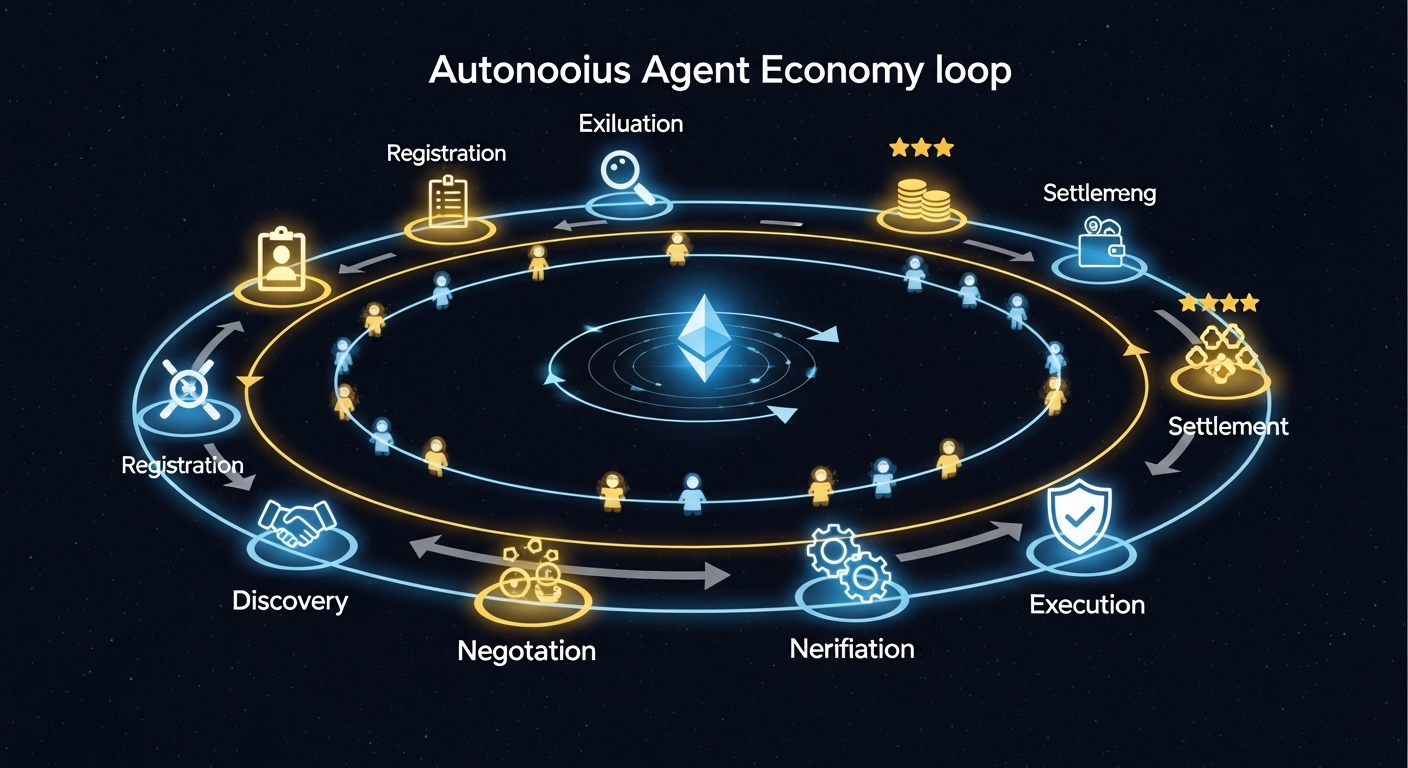
When you connect all the layers, a self-reinforcing economic loop appears:
- Register: An agent mints an ERC-8004 identity with its capabilities (“I can refactor TypeScript codebases, fix security vulnerabilities, write test suites”)
- Discover: Another agent or marketplace queries the Identity Registry, discovers candidates by skill tags
- Evaluate: The client checks the Reputation Registry, filtered by trusted reviewers
- Negotiate: Terms are agreed via x402 or a commerce protocol like ACP
- Execute: The agent performs the work autonomously
- Verify: Optionally, a validator re-checks the work via the Validation Registry
- Settle: Payment flows instantly via USDC on Base
- Rate: The client posts feedback to the Reputation Registry, improving the agent’s discoverability for future tasks
This is no longer a thought experiment. It’s infrastructure that 21,000+ agents are already using. The Ethereum Foundation has identified 40-50 teams actively building trading agents on ERC-8004 alone, with additional teams building code review services, gaming implementations, research assistants, and data analysis agents.
Between 1,000 and 2,000 builders have joined development groups since the specification was published.
What This Means for the Next 12 Months
The convergence of ERC-8004, x402, Agentic Wallets, and commerce protocols like ACP creates conditions for several developments:
The Skill Economy Goes On-Chain
Today, AI agent skills are platform-specific. An agent’s capabilities are defined by the platform that hosts it, visible only within that ecosystem. ERC-8004’s Identity Registry makes skills discoverable across the entire Ethereum ecosystem. Any platform can query any agent’s registration file and understand what it does, how to talk to it, and whether to trust it.
Reputation Becomes a Moat
Early movers who build strong on-chain reputations will have a structural advantage. An agent with 500+ positive reviews and a 95+ score in a specific skill category is worth fundamentally more than an identical agent with no track record. And because ERC-8004 reputation is portable, that advantage carries across platforms.
Dynamic Pricing Emerges
As reputation data accumulates, expect marketplaces to implement reputation-weighted pricing. New agents discount their rates to build reputation. Established agents charge premiums. The market clears based on verifiable quality signals, not marketing.
Agents Hire Agents
This is the least intuitive but most consequential development. With identity, reputation, and payment infrastructure in place, agents don’t just serve human clients—they hire each other. An orchestrator agent that needs data cleaned can query the registry, find a data-cleaning agent with a strong track record, negotiate terms via x402, pay in USDC, verify the output, and post a review. No human in the loop.
The Unsolved Problems
ERC-8004 is live, but the standard’s authors are candid about what remains unsolved.
Sybil resistance is the obvious one. The protocol prevents self-reviews at the contract level, but sophisticated actors can create multiple identities to boost each other’s ratings. The community discussion on Ethereum Magicians surfaced several defense mechanisms—payment-value weighting, graph analysis (SybilGuard, SybilRank), reviewer diversity metrics—but none are enforced at the protocol level. They’re left to off-chain aggregators and individual marketplaces.
Cross-chain reputation aggregation isn’t standardized. An agent’s reputation on Base doesn’t automatically compose with its reputation on Arbitrum. The registries share addresses, but aggregation logic lives off-chain.
Validator economics remain domain-specific. How much should validators stake? What are the slashing conditions? How are rewards distributed? ERC-8004 provides the hooks but intentionally leaves the economics to implementers, which could lead to fragmentation.
Reputation NFT transferability creates a subtle risk. If a high-reputation identity is sold, the new owner inherits the trust signals. The wallet-binding reset helps, but doesn’t fully solve the problem. Time-weighted scoring and post-transfer discount periods are proposed mitigations.
These are real challenges. But they’re the kind of challenges that get solved through iteration in production, not through longer specification processes. The standard is live. The builders are iterating.
The Quiet Revolution
There’s a recurring pattern in platform shifts: the most consequential infrastructure launches don’t generate proportional hype.
ERC-8004’s mainnet launch barely moved Ethereum’s price. Sentiment scores during the rollout hit their lowest of the year—90% below the Pectra upgrade baseline. Analysts noted that the standard’s benefits are “structurally important, but not yet visible to most market participants.”
That’s usually a good sign.
The organizations that built ERC-8004—MetaMask, Ethereum Foundation, Google, Coinbase—aren’t optimizing for token price. They’re building settlement infrastructure for a new category of economic actor. The 40-50 teams building on it, the 21,000+ registered agents, the 50 million x402 transactions—these are the leading indicators.
The lagging indicator will be the first agent that earns more than its creator expected. The first marketplace where reputation scores drive real pricing differentials. The first autonomous supply chain where agents discover, hire, verify, and pay each other without a single human transaction.
That’s not a prediction. It’s a description of what’s already being built.
This analysis synthesizes research from 30+ sources including the ERC-8004 specification, Ethereum Magicians community discussion, Stripe’s x402 documentation, Virtuals Protocol announcements, and coverage from CoinDesk, CCN, and CryptoRank. For the full research archive, see our research notes.
Sources
- ERC-8004: Trustless Agents - Official Ethereum Improvement Proposal
- ERC-8004 Contracts Repository - Official implementation
- ERC-8004: A Practical Explainer for Trustless Agents - Composable Security
- Reputation as an Economic Primitive: The Case for ERC-8004 - HackerNoon
- ERC-8004: Trustless Agents Discussion - Fellowship of Ethereum Magicians
- Awesome ERC-8004 - Ecosystem overview
- Stripe x402 Payments Documentation - Stripe
- Stripe Taps Base for AI Agent x402 Payment Protocol - Crypto News
- Introducing Agentic Wallets - Coinbase
- Virtuals Protocol Launches Revenue Network - PR Newswire
- What Is ERC-8004? Ethereum’s New Agent Standard - Bitcoin.com
- Ethereum Foundation Targets AI Agent Commerce - Yellow Network
- AI Agent Payment Infrastructure - Tiger Research
- AI in 2026: 3 Trends - a16z crypto
- ERC-8004 Gives AI Agents Identity - RedStone Finance
- The Story Behind ERC-8004 & Next Steps - Marco De Rossi
- Davide Crapis on ERC-8004 - Unchained / Crypto Briefing
- Changpeng Zhao: Banks Are Not Ready for the AI Agent Economy - BTCUSA