ERC-8004 Launch Day: The Moment AI Agents Got Their Own Internet
Inside the event that brought MetaMask, Google DeepMind, Coinbase, and the Ethereum Foundation together to celebrate trustless AI agents going live on mainnet.
On March 17th, a virtual room filled with builders, researchers, and protocol designers from across the Ethereum ecosystem to mark a milestone that had been months in the making: the conclusion of Genesis Month and the mainnet maturation of ERC-8004 — the Ethereum standard that gives AI agents identity, reputation, and trust on-chain.
The event wasn’t a product launch. It was a signal. The builders who showed up weren’t pitching vaporware — they were demoing production systems already processing millions of transactions and managing tens of millions in assets. When MetaMask’s AI Lead, Google DeepMind’s Senior Staff Research Scientist, and Coinbase’s Head of Developer Platform Engineering are all in the same room talking about the same standard, something real is happening.
Here’s what went down — and why it matters.
What Is ERC-8004?
Before diving into the presentations, a quick primer. ERC-8004, titled “Trustless Agents,” is an Ethereum standard co-authored by Marco De Rossi (MetaMask), Davide Crapis (Ethereum Foundation), Jordan Ellis (Google), and Erik Reppel (Coinbase). It was drafted in August 2025 and went live on Ethereum mainnet on January 29, 2026.
The problem it solves: Google’s Agent-to-Agent (A2A) protocol and Anthropic’s Model Context Protocol (MCP) handle how AI agents communicate and access tools — but neither addresses how agents discover each other or establish trust without a centralized gatekeeper.
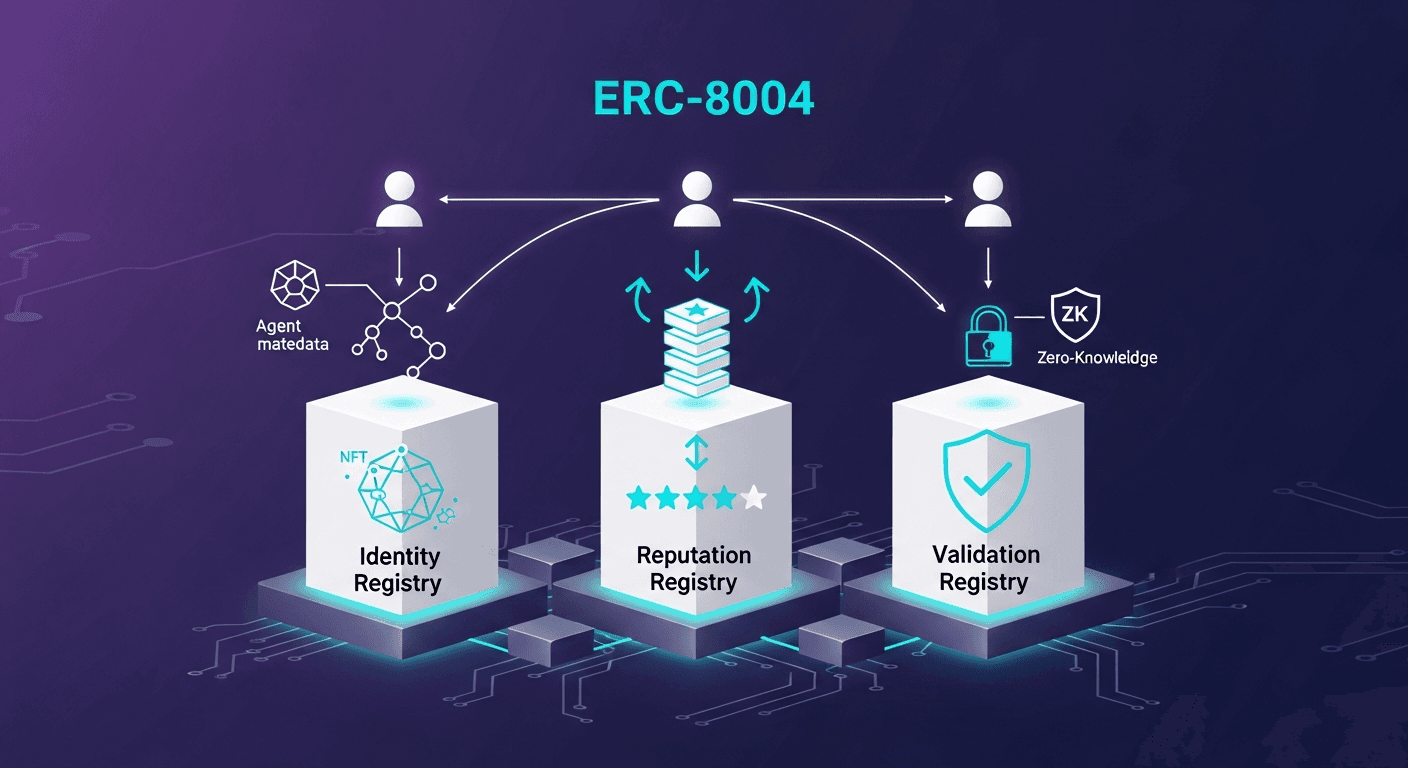
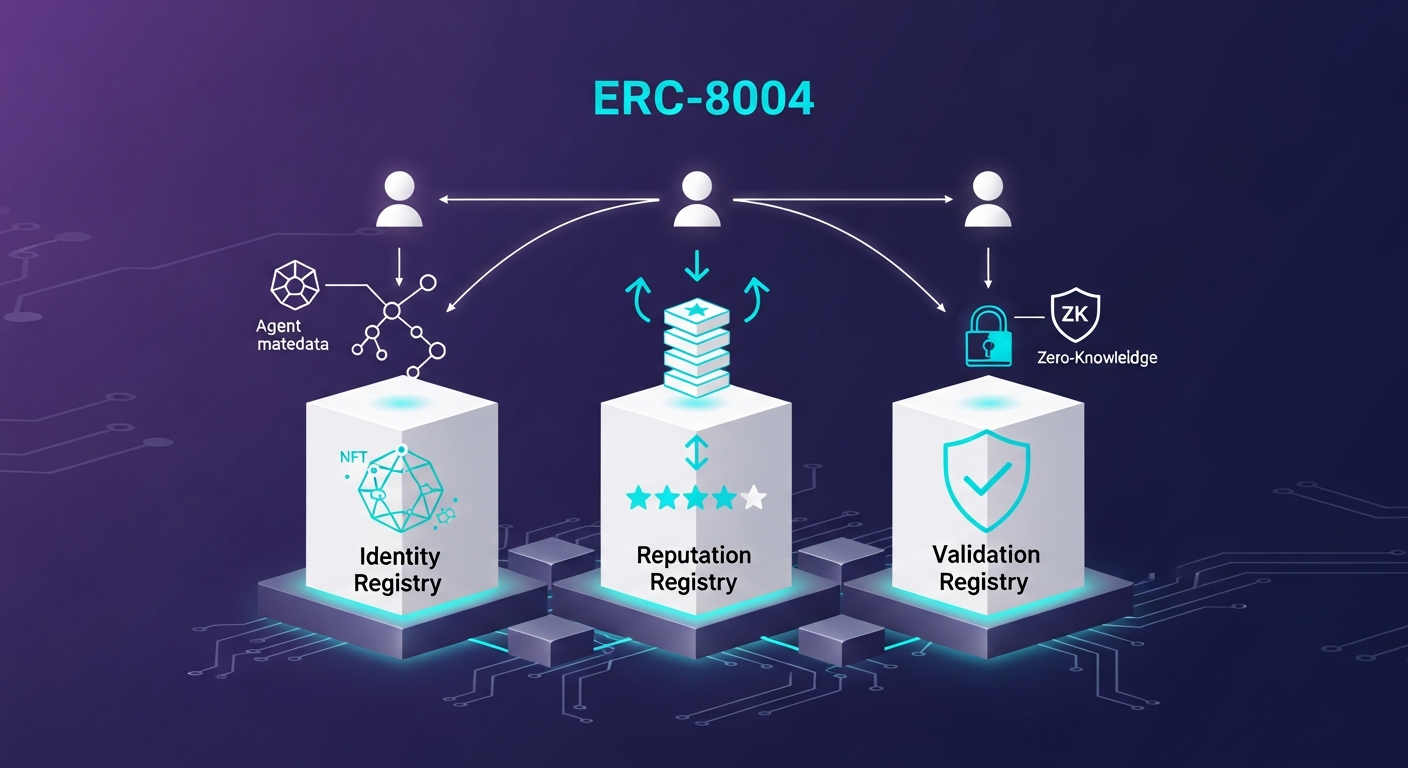
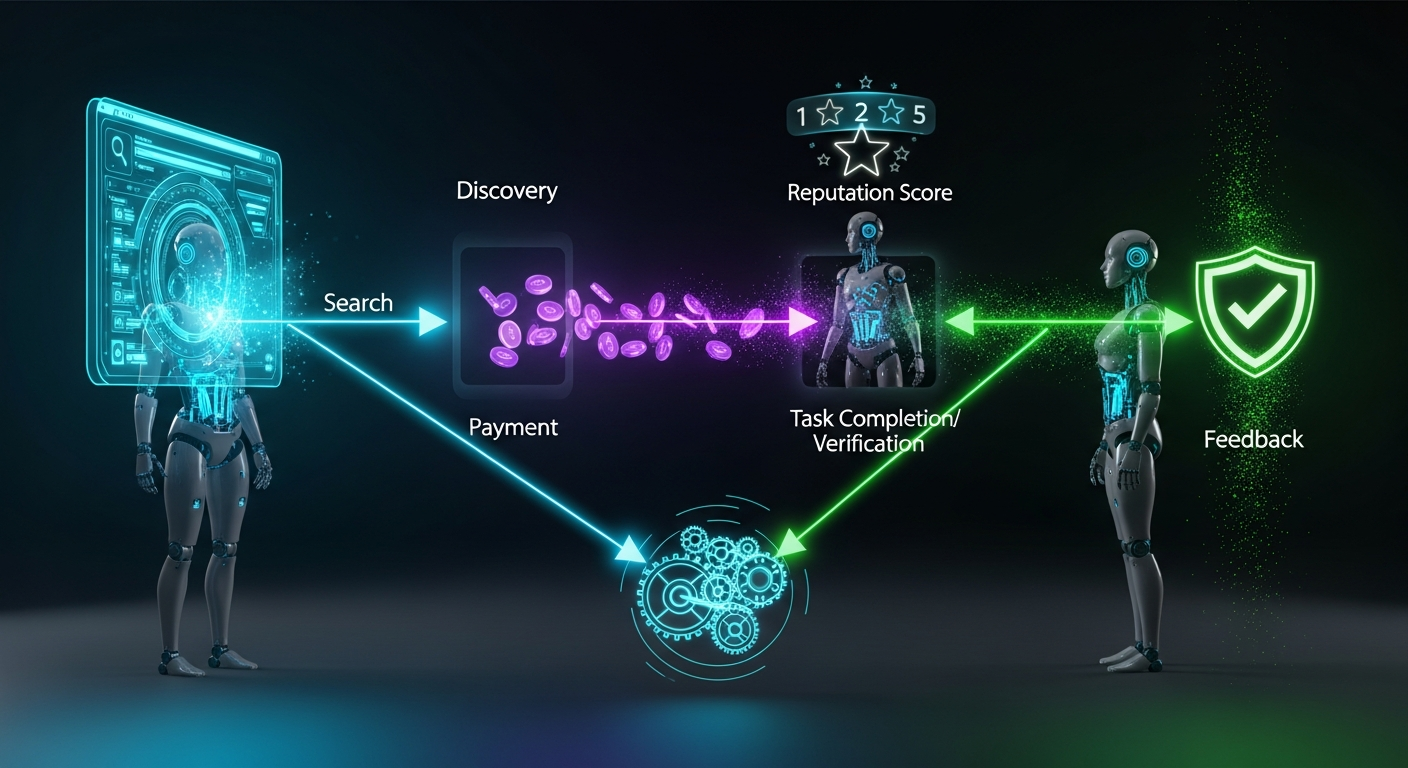
ERC-8004 adds three lightweight on-chain registries:
-
Identity Registry — Each agent mints an ERC-721 NFT as a globally unique identifier, pointing to a structured metadata file with its name, capabilities, service endpoints (MCP, A2A), and payment address.
-
Reputation Registry — Any client can submit fixed-point feedback scores on agents, creating composable on-chain reputation. Complex scoring algorithms run off-chain; raw signals live on-chain for transparency.
-
Validation Registry — Enables third-party verification through multiple strategies: staked re-execution, zero-knowledge ML proofs, and TEE oracle attestations.
Since mainnet launch, adoption has been explosive: from 337 registered agents at the start of 2026 to nearly 130,000 across multiple chains. BNB Smart Chain now hosts the most ERC-8004 agents (34,278), followed by Base (16,549) and Ethereum mainnet (~14,000).
The Opening: Marco De Rossi Sets the Stage
Marco De Rossi, MetaMask’s AI Lead and the primary originator of ERC-8004, opened the event. De Rossi has been vocal about his philosophical motivation for the standard: he sees a future where AI agents mediate most human-to-service interactions, and he’s alarmed by the prospect of that future being controlled by a handful of centralized platforms acting as gatekeepers.
“Think about the physical world,” De Rossi has written. “You can find people and assess their trustworthiness without a corporate intermediary. The AI agent world should work the same way.”
At MetaMask, De Rossi leads work on the Delegation Toolkit — a permissions framework that lets users grant AI agents bounded spending authority over their wallets (defining which assets, spending limits, time windows) without ever surrendering private keys. It’s the self-custody answer to the question: how do you let an autonomous agent spend your money safely?
The Builders: What’s Already Live
Olas — Prediction Market Agents Outperforming Humans
Olas, one of the earliest crypto-native AI agent platforms (founded 2021), showcased its ecosystem of 3,283+ deployed agents with 11 million+ agent-to-agent transactions. The standout: Polystrat, their prediction market trading agent on Polymarket, which has executed 4,200+ trades with single-trade returns as high as 376%.
The numbers that turn heads: 37% of Polystrat agents show positive P&L, compared to less than 18% for human traders. And this isn’t an isolated phenomenon — over 30% of Polymarket wallets now use AI agents.
Olas pioneered the pattern of registering agents as ERC-721 NFTs on-chain — the same approach that ERC-8004 later standardized across Ethereum. Their Pearl app store gives users access to pre-built agents spanning prediction markets, DeFi, and social media, all coordinated through the OLAS token’s staking and incentive mechanisms.
Virtuals Protocol — 18,000 Agents, $470M in Agentic GDP
Virtuals Protocol brought perhaps the most impressive scale numbers to the event: 18,000+ agents created on their platform, $470M+ in cumulative Agentic GDP (their measure of total value produced by autonomous agents), and $39.5M+ in protocol revenue.
Built primarily on Base (Coinbase’s L2), Virtuals operates a full agent economy where autonomous AI agents generate services, produce outputs, and transact through smart contracts. Their Agent Commerce Protocol (ACP) handles the complete lifecycle of agent-to-agent commerce: discovery, hiring, escrow, execution, evaluation, and settlement — all on-chain.
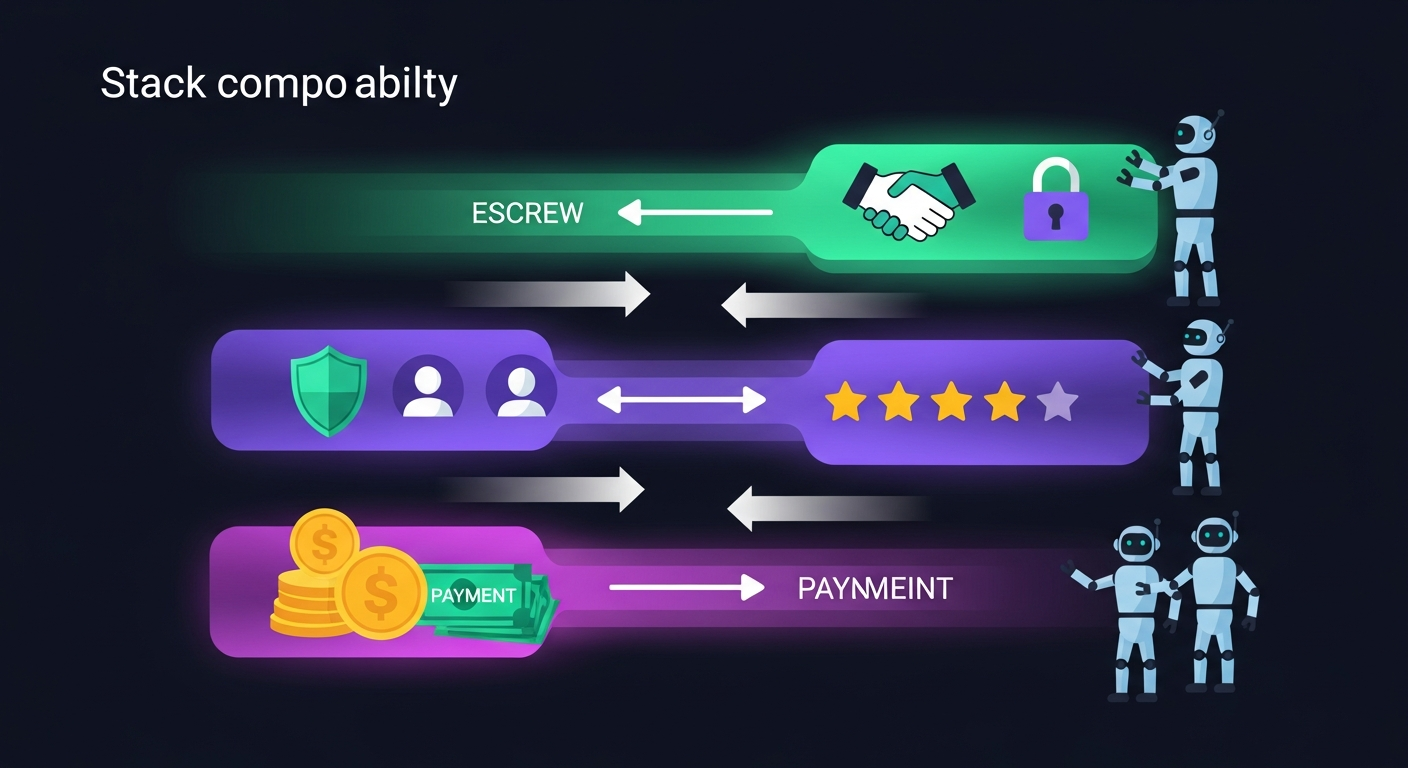
A key announcement: Virtuals co-developed ERC-8183 with the Ethereum Foundation’s dAI team — a new standard for trustless conditional commerce between agents that introduces job escrow primitives. Together with x402 (micropayments) and ERC-8004 (identity/trust), ERC-8183 completes a three-layer infrastructure stack for the agentic economy. Virtuals also confirmed that all graduated ACP agents will be automatically registered on ERC-8004.
RedStone — The Oracle Layer for Agent Intelligence
RedStone, the modular oracle provider with $4.9 billion in Total Value Secured across 110+ blockchains, presented its positioning as the data infrastructure layer for ERC-8004 agents.
The thesis is elegant: legacy push oracles broadcast data constantly to every contract — a firehose approach. AI trading agents need a precision instrument. RedStone’s pull-model architecture lets agents request exactly the data they need at the moment of decision, eliminating unnecessary gas costs. Their newest product, RedStone Bolt, streams price updates into every block on ultra-high-throughput chains like MegaETH, delivering updates at ~2.4ms intervals.
Combined with Credora’s institutional-grade credit risk scores, RedStone gives AI agents both real-time market data and risk intelligence — the two inputs an autonomous DeFi agent needs to make sound decisions. Their recent work with Securitize brings $580M of BlackRock’s BUIDL fund into the picture, with daily on-chain NAV feeds that AI agents can consume directly.
The Keynotes: Industry Giants Weigh In
Erik Reppel — Coinbase: “Fixing the Internet’s Original Sin”
Erik Reppel, Head of Engineering for Coinbase Developer Platform and co-author of ERC-8004, presented the x402 protocol — an open payment standard that gives the internet a native money layer for AI agents.
The flow is simple: when an AI agent calls another agent’s API and receives an HTTP 402 (“Payment Required”) response, x402 automatically parses payment options, pays in USDC on-chain, and retries — all in one seamless flow. No Stripe. No accounts. No OAuth. Just wallets and stablecoins.
Reppel frames this as fixing what Marc Andreessen called “the original sin of the internet” — the absence of native payments. For AI agents operating at machine speed, traditional payment rails are impossibly slow. x402 enables sub-second, sub-cent USDC settlements in approximately 200ms.
Coinbase’s broader agent infrastructure was also on display: AgentKit (their flagship SDK for building on-chain AI agents), Agentic Wallets (wallets designed specifically for autonomous agents), and a recent integration with World (Sam Altman’s identity project) that allows agents to carry cryptographic proof they represent a real human.
Nenad Tomasev — Google DeepMind: The Theory Behind the Standard
Nenad Tomasev, Senior Staff Research Scientist at Google DeepMind with 24,000+ citations, brought the academic rigor. His February 2026 paper “Intelligent AI Delegation” proposes a framework for safe agent-to-agent task delegation grounded in principal-agent theory and cryptoeconomic security.
The paper’s five pillars — dynamic assessment, adaptive execution, structural transparency, scalable market coordination, and systemic resilience — map directly onto what ERC-8004’s registries operationalize. Tomasev’s framework proposes Delegation Capability Tokens, contract-first task decomposition, and decentralized agent markets — mechanisms that align with ERC-8004’s on-chain identity and validation infrastructure.
His presence at the event was significant: it signals that DeepMind recognizes multi-agent trust as a problem requiring decentralized, cryptographic solutions — not just better centralized oversight. When one of the world’s leading AI research labs endorses the architecture behind an Ethereum standard, the crypto-AI convergence moves from speculation to inevitability.

The Builders, Part Two: Infrastructure and Tools
ZyFai — DeFi Yield with ZK-Verified Agent Actions
ZyFai, incubated by the Ethereum Foundation, demonstrated one of the deepest ERC-8004 integrations at the event. Their agentic yield layer manages $10.5M in deposits through autonomous DeFi optimization, executing 135,000+ rebalances.
The technical innovation: each rebalance generates a zero-knowledge proof that gets logged to ERC-8004’s Validation Registry on-chain, creating a verifiable audit trail. Users deposit into self-custody smart contract wallets and grant the ZyFai agent session keys with predefined parameters — the agent optimizes yields across curated lending protocols without the user ever giving up custody.
ZyFai also exposes its backend via an MCP server accessible through ERC-8004, meaning external AI agents can call ZyFai’s yield strategies directly — agent-to-agent DeFi composability in action.
8004scan — Etherscan for AI Agents
8004scan, created by AltLayer, is exactly what it sounds like: a block explorer built specifically for the ERC-8004 ecosystem. It aggregates data from all three registries into a searchable interface where you can discover agents by capability, filter by supported protocols (MCP, A2A, OASF), evaluate trust via reputation scores, and submit feedback.
With published v2.0 best practices documentation covering agent metadata standards, feedback mechanisms, validation frameworks, and attachment patterns, 8004scan is building the developer tooling layer that any healthy standard needs to scale.
Bond.Credit — Credit Scores for Autonomous Agents
Bond.Credit asks a simple but profound question: which agents can be trusted with credit?
Their platform deploys real capital to on-chain AI agents and tracks performance to build credit scores. Season 0 of their “Agentic Alpha” program routed capital to five agents (including ZyFai) to benchmark whether AI agents outperform static DeFi vaults. High-performing agents earn credibility, unlock higher credit limits, and receive increased capital allocation.
It’s the credit rating system for autonomous agents — and it sits naturally alongside ERC-8004’s Reputation Registry as the application layer that turns raw reputation data into actionable lending decisions.
Agent0 — The Reference Implementation
Agent0 is the canonical SDK implementation of ERC-8004, created by Marco De Rossi himself. Available in both Python and TypeScript, it provides the four primitives developers need: on-chain identity registration, capability advertising via MCP/A2A endpoints, permissionless discovery and search, and structured reputation feedback — plus x402 micropayment support for automatic agent-to-agent payments.
If ERC-8004 is the standard, Agent0 is the starting point for anyone building on it.
DayDreams — Commerce Infrastructure at Scale
DayDreams, self-described as a “commerce harness for agents,” showed what it looks like when the full stack comes together. Their DREAMS Router processes 1.3 million+ model calls per month via USDC micropayments on Base mainnet — real economic activity flowing through agent infrastructure.
Their open-source Lucid Agents TypeScript framework offers adapters for Hono, TanStack, Express, and Next.js, integrating x402 payments, ERC-8004 identity, A2A communication, and AP2 agent payment protocol into a single modular stack. Their XGate discovery engine indexes x402 endpoints and ranks agents by payment flows and reputation — what they call “Agent Engine Optimization,” the SEO of the machine economy.
Closing: Davide Crapis and What Comes Next
Davide Crapis, Head of AI at the Ethereum Foundation and co-author of ERC-8004, delivered the closing remarks. Since founding the dAI team in June 2025, Crapis has been laser-focused on one thesis: making Ethereum the preferred settlement and coordination layer for AIs and the machine economy.
The numbers suggest the thesis is working. Nearly 130,000 agents registered. Multiple chains deploying the standard. Real capital flowing through agent systems. And the caliber of the speakers — MetaMask, Google DeepMind, Coinbase, the Ethereum Foundation — signals that ERC-8004 isn’t a niche experiment. It’s becoming infrastructure.

Five Takeaways
1. The agents are already here. This wasn’t a roadmap presentation. Olas has agents outperforming human traders. Virtuals has $470M in agent-generated economic output. ZyFai is managing $10.5M in real deposits. DayDreams is processing 1.3M model calls per month. The question is no longer “will agents work?” but “how fast will they scale?”
2. The trust stack is forming. ERC-8004 (identity and reputation) + ERC-8183 (conditional commerce) + x402 (micropayments) creates a complete infrastructure layer for autonomous agent economies. Each piece was represented at the event, and they’re already being used together in production.
3. The biggest players are aligned. When Google DeepMind, MetaMask, Coinbase, and the Ethereum Foundation all co-author or endorse the same standard, it’s not just an Ethereum thing — it’s becoming the default. BNB Smart Chain already adopted it. Mantle deployed it. The multi-chain expansion is underway.
4. DeFi is the proving ground. The majority of live ERC-8004 agents operate in DeFi — trading, yield optimization, lending. This makes sense: DeFi has the clearest agent-money interface and the most immediate ROI. But gaming, social, and infrastructure agents are coming.
5. The credit layer is next. Bond.Credit’s approach — deploying real capital to agents and building credit scores from performance — points to the next evolution. Once agents have identity (ERC-8004) and can transact (x402), the logical next step is creditworthiness. Agents that prove themselves get more capital, more trust, more opportunity. It’s the beginning of an autonomous economy.
The ERC-8004 Launch Day was hosted by the 8004 Builder Community, presented by Vittorio Rivabella (AI Coordinator, Ethereum Foundation). For more information on building with ERC-8004, visit ag0.xyz (SDK), 8004scan.io (explorer), and the EIP specification.