The OpenClaw Orchestrator Ecosystem: How AI Agent Teams Are Solving Production Challenges
The Promise and the Reality
When OpenClaw emerged as an open-source autonomous AI agent framework, the pitch was straightforward: deploy once, set it free, let agents work 24/7 with minimal human oversight.
That vision was compelling. And partially right.
But a deep analysis of 7 major orchestration projects and 8 technical guides built on OpenClaw in 2025-2026 reveals a more nuanced reality: the market has quietly evolved past pure autonomy and into sophisticated orchestration systems that balance agent intelligence with human governance, deterministic control flow, and measurable economics.
This evolution tells us something important: AI agents are becoming infrastructure, not just clever assistants. And infrastructure demands governance, reliability, and cost accountability.
Part 1: The Orchestration Stack Emerges
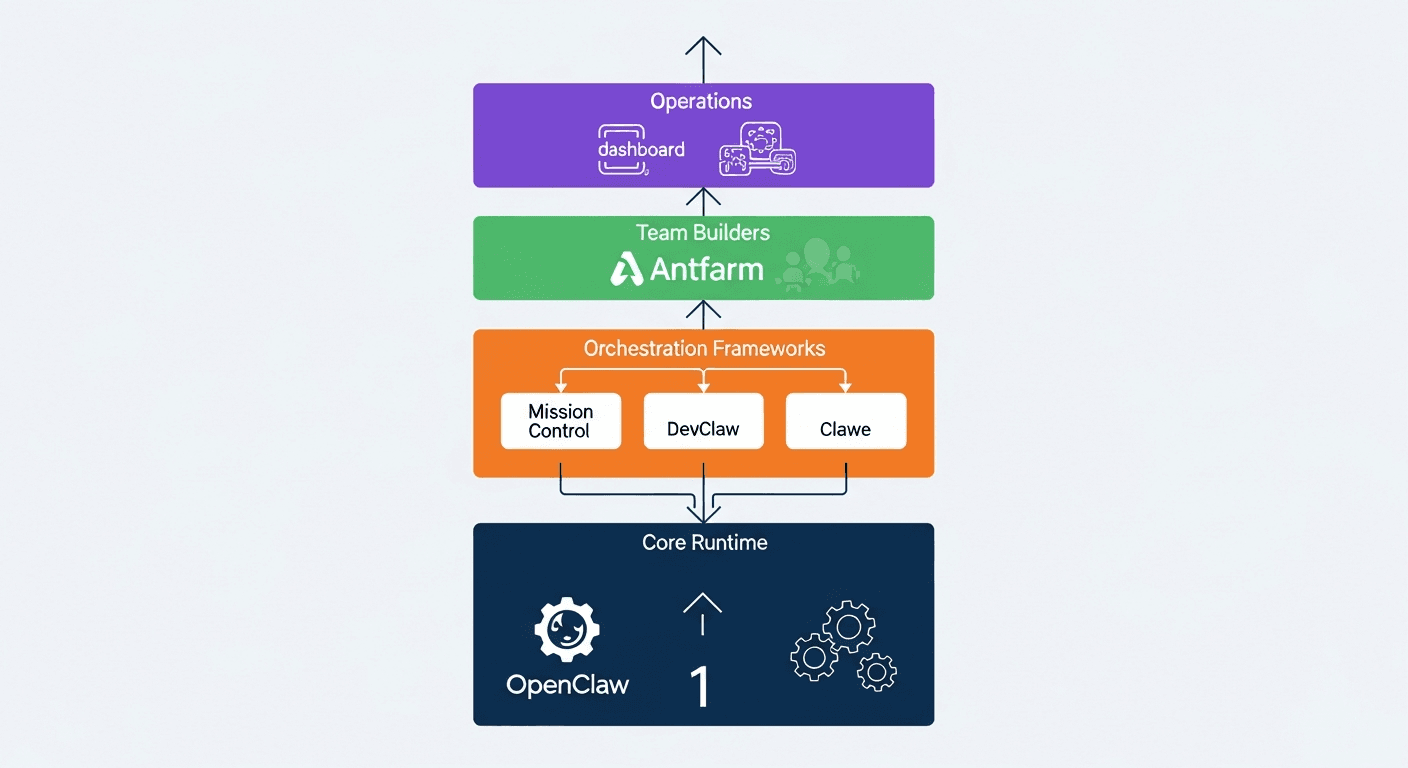
The most striking pattern in the OpenClaw ecosystem is architectural clarity. Rather than forking OpenClaw or building monolithic competitors, teams are building abstraction layers on top of the core runtime.
Layer 1: The Core Runtime
OpenClaw handles the fundamentals: agent execution, skill management, persistent state, and integration with messaging platforms (Slack, Telegram, Discord). This is the kernel—it works well and most teams don’t need to fork it.
Layer 2: Orchestration Frameworks
This is where specialization happens. Three major projects occupy this layer:
Mission Control adds governance and enterprise operations: agent lifecycle management, approval workflows, audit trails, and unified dashboards. It transforms OpenClaw from a tool that works autonomously into a tool that works within organizational constraints.
DevClaw adds domain-specific pipeline orchestration. Instead of agents interpreting workflow instructions, DevClaw uses deterministic plugin code to sequence dev/qa agents (programmer, reviewer, tester). This trades flexibility for reliability.
Clawe adds visual task coordination, reimagining agent orchestration as a Trello-like task board. This is pure UX layering—it doesn’t change how agents work, just how humans understand what they’re doing.
Layer 3: Team Builders
Antfarm lets teams spin up a complete agent composition with one command. Rather than each project figuring out how to coordinate planner, developer, reviewer, and tester agents, Antfarm provides pre-built, battle-tested team templates.
Layer 4: Operations
Claworc runs multiple isolated OpenClaw instances from a single control panel, solving the problem of managing agent deployments across teams and organizations. It’s the orchestrator for orchestrators.
This layering is crucial. It shows the ecosystem is maturing—teams aren’t competing on core agent intelligence anymore. They’re competing on orchestration, governance, and operational tooling.
This mirrors how software ecosystems have historically evolved: Linux kernel → operating systems → frameworks → applications. OpenClaw has crossed that inflection point.
Part 2: The Governance Gap (And How It Got Solved)
Here’s where the market surprised the original architects.
What OpenClaw Originally Promised
Autonomous agents. No human in the loop. Set it running and trust the system to figure things out. This is appealing because it’s efficient—no approval delays, no human bottlenecks, pure automation.
What Enterprise Deployments Actually Need
Audit trails. Approval workflows for high-stakes decisions. Compliance checkpoints. The ability to override agent decisions. Rollback capabilities. Error handling protocols. Accountability.
The irony: the more sophisticated and capable agents become, the more governance they require. Autonomous agents are acceptable for learning tasks, but production systems demand oversight.
How the Ecosystem Solved It
Mission Control elegantly balances autonomy with oversight. Agents remain autonomous within guardrails. A human approval layer sits at decision points: “agent wants to deploy this code—approve or reject?” This isn’t a compromise—it’s the right architecture for production systems.
Every successful orchestration project made this trade-off. DevClaw uses deterministic control flow. Claworc enforces isolated containers with strong authentication. Antfarm pre-builds team compositions rather than letting agents self-organize.
The lesson: production orchestration isn’t about maximum autonomy. It’s about controlled autonomy—agents making decisions with human oversight and clear accountability.
Part 3: Why Routing Became the Bottleneck
Here’s an insight that separates production experience from theoretical discussions:
Agent intelligence has become commodity. Routing has become the art form.
The Routing Problem
When multiple agents exist in a system, the core question becomes: which agent should handle this task? When? With what context?
This sounds simple. It’s not.
Routing Patterns (In the Wild)
Sophisticated orchestration systems combine three routing strategies:
Rule-based routing: if task_type=“code_review” then send to reviewer_agent. Simple, predictable, inflexible.
Load-based routing: assign task to least-busy agent. Prevents bottlenecks but can assign complex work to unprepared agents.
Capability-based routing: assign task to agent with relevant skills/training. Sophisticated but requires continuous capability inventory.
Production systems use all three, plus:
- Priority queues (some tasks are more urgent)
- Context threading (agents need relevant history)
- Error recovery (what happens when assigned agent fails?)
- Escalation (when to involve humans?)
Why This Matters
In distributed systems literature, there’s a known insight: scaling isn’t about making individual nodes smarter—it’s about coordinating them effectively.
OpenClaw teams learned this through production experience. You can have brilliant agents, but if you route work poorly, your system fails. Routing sophistication has become the gating factor for reliable orchestration.
This is why DevClaw, Clawe, and Mission Control all built sophisticated routing layers. It’s not accidental. It’s where the pain lives.
Part 4: Dev/QA as the Strategic Beachhead
Why do so many orchestration projects focus on development and QA workflows?
The answer reveals a lot about where AI agents actually add value. Projects like DevClaw, Antfarm, and others have made dev/QA their primary focus.
The Three Superpowers of Dev/QA Workflows
1) Measurable Success Tests pass or fail. Code is correct or buggy. You have objective, binary evaluation criteria. This is rare in knowledge work. Most professional tasks involve judgment calls, ambiguity, and trade-offs.
With dev/QA, you can measure agent performance directly. “This agent reviewed 50 code changes. 48 were caught valid bugs, 2 were false positives.” Objective performance metrics are possible.
2) High Economic Value Software engineers cost $150-300/hour. Code review, testing, and debugging are expensive. Automating these workflows has immediate, measurable ROI.
Compare to general knowledge work (research, writing, strategy), where automation value is harder to quantify.
3) Familiar, Established Patterns CI/CD pipelines, code review processes, testing strategies—these are well-understood, standardized practices. Teams already think in these mental models. There’s no need to invent new orchestration patterns.
The Surprising Finding: Agents Aren’t Universally Good at Knowledge Work
ClawWork tested agents on 220 professional tasks spanning 44 sectors. The pattern was stark: agents crushed structured, iterative work but struggled with ambiguous, judgment-heavy tasks.
This has major implications for AI strategy. Orchestrated agents aren’t universally good at “knowledge work”—they’re specifically good at bounded problem-solving with clear success criteria.
This should guide how teams deploy agents:
- Identify high-value, well-bounded problems first (dev/qa, data processing, routine analysis)
- Master those use cases thoroughly (build reputation, prove ROI)
- Expand into adjacent, slightly-more-complex domains (financial analysis, legal review, customer support)
The teams that follow this beachhead strategy will scale faster than teams trying to build general-purpose agent systems.
Part 5: The Ecosystem Hit Critical Mass
OpenClaw’s community skill registry (ClawHub, see Awesome OpenClaw Skills) now hosts 5,705 community-built skills as of February 2026.
Why This Matters: The Network Effect Inflection Point
Compare to mature ecosystems:
- npm (JavaScript packages): 2.7 million packages (very mature market)
- Kubernetes (Helm charts): 100,000+ charts (mature infrastructure)
- OpenClaw (skills): 5,705 (critical mass recently crossed)
The important metric isn’t the absolute number—it’s that the ecosystem has crossed the network effects inflection point. This means:
- Adding a new skill is easy (API is stable, documentation is good)
- Finding existing skills is possible (discoverability works)
- Community contribution is incentivized (people build for others)
- Switching costs are real (losing 5,700+ integrations matters)
Good Lock-in vs. Bad Lock-in
This creates lock-in. But it’s good lock-in:
Bad lock-in (proprietary platforms): You’re stuck because you can’t access the source code or migrate your data. Extraction-based.
Good lock-in (open-source with ecosystem): You could theoretically fork and leave, but you’d lose access to 5,700+ community contributions. Value-based.
OpenClaw’s MIT license + massive skill ecosystem creates sustainable competitive advantage. Teams stay because the platform is genuinely valuable, not because they’re legally trapped.
This is how you build long-term moats in open-source infrastructure.
Part 6: The Economics Blind Spot
Here’s the question nobody in the ecosystem has fully answered: What’s the economic case for always-on agent deployment?
The Claim
ClawWork claims $10K earned in 7 hours—a compelling headline for agent ROI.
The Missing Analysis
- What were the compute costs? (Fly.io is ~$10-15/month per agent)
- What’s the failure rate? (What % of tasks need human rework?)
- What’s the capital cost? (Development, testing, deployment)
- What’s the full break-even analysis?
The ecosystem has solved the technology problem (agents work, orchestration works). But it hasn’t solved the economics problem (when does always-on deployment pencil out for different use cases?).
Why This Matters
Teams considering agent deployment need cost frameworks. “Cheaper than humans” is a compelling pitch, but without:
- ROI calculators
- Break-even analyses
- Cost-benefit templates
- Failure rate expectations
…teams will hesitate to commit real capital.
The team that ships transparent cost analysis tools wins a significant market segment. This isn’t technical innovation—it’s business rigor applied to AI infrastructure.
Part 7: The Autonomy vs. Control Dichotomy is Resolved
The market resolved an important philosophical question: how much autonomy should agents have?
The Original Premise: Autonomy is Good
Early OpenClaw marketing promised fully autonomous agents. Free agents that learn, adapt, self-organize. This is appealing because it’s efficient and elegant.
The Market Reality: Controlled Autonomy is Better
Production systems don’t want fully autonomous agents. They want agents that work within guardrails, with human oversight and clear accountability.
The Synthesis: Agents + Determinism
The winning pattern that emerged across all successful projects:
- Agents handle intelligence: understanding goals, adapting to context, solving novel problems
- Deterministic layers handle control: sequencing decisions, enforcing compliance, managing error recovery
DevClaw doesn’t remove agent autonomy—it layers deterministic pipeline logic around agent decision-making. Mission Control doesn’t remove agent autonomy—it adds approval checkpoints.
This isn’t a weakness or compromise. It’s the right architecture for production systems.
Pure autonomy works for learning tasks. Controlled autonomy works for business-critical systems.
Part 8: What’s Next (Three Predictions)
Prediction 1: Governance Becomes Table-Stakes (Q1-Q2 2026)
Enterprise customers already demand approval workflows, audit trails, and compliance checkpoints. Mission Control’s pattern spreads across the ecosystem. By end of Q2, orchestration without governance won’t be competitive for professional use.
Prediction 2: Multimodal Orchestration Emerges (Q3-Q4 2026)
Right now, orchestration is entirely text-based. The frontier is voice agents, vision agents, and cross-modal coordination (text→vision→voice chains).
Currently, only one research proposal seriously explores multimodal orchestration. This suggests either it’s too early (still researching architecture) or too hard (few teams attempting it).
Prediction: the first team to crack multimodal orchestration defines the standard architecture. Early-movers in multimodal own the next wave.
Prediction 3: Domain-Specific Orchestrators Emerge (Q4 2026 onwards)
General-purpose agent teams are harder than specialized teams. Expect orchestration platforms optimized for:
- Legal workflows (contract review, precedent analysis)
- Financial analysis (earnings analysis, compliance reporting)
- Medical coding (ICD-10 classification, clinical documentation)
All built on OpenClaw. The beachhead strategy (start with high-value bounded use cases) scales.
Practical Takeaways
For Teams Building Orchestration Tools
Look at projects like Mission Control, DevClaw, Clawe, and Claworc for reference implementations:
-
Invest in routing abstraction early. This is where the pain lives. Agent capability is table-stakes. Routing sophistication wins competitive battles.
-
Build governance in from day one. Approval workflows, audit trails, compliance checkpoints aren’t bolts-on features. They’re architectural requirements for professional systems.
-
Provide transparent cost analysis. The team that ships the first honest ROI calculator owns a market segment. Cost visibility builds trust.
For Teams Deploying Agents
-
Start with high-value, well-bounded problems. Dev/QA is proven. Find similar beachheads in your domain.
-
Measure before scaling. Quantify success criteria. Build cost models. Don’t deploy broadly until you’ve proven ROI narrowly.
-
Plan for multimodal. Text-based orchestration is current. Voice, vision, and cross-modal are coming. Prepare architectures accordingly.
Conclusion: Infrastructure, Not Magic
The OpenClaw ecosystem has answered the foundational question: Can AI agents orchestrate reliably at scale?
The answer is yes.
Seven production-grade projects proved it works. Hundreds of community contributions validated the ecosystem. 5,700+ skills demonstrate market maturity.
Now the market is asking deeper questions:
- Governance: How do we control agents within organizational constraints?
- Economics: What’s the ROI for always-on deployment?
- Reputation: How do we build trust in agent teams?
- Multimodal: How do we orchestrate beyond text?
The teams that answer these questions shape the next era of AI infrastructure.
OpenClaw went from “can agents be useful?” to “how do we orchestrate agents reliably?” in just a few years. That progression from novelty to infrastructure is the most important signal the ecosystem can send.
The next frontier isn’t technical—it’s organizational and economic. Governance, cost clarity, reputation systems, and domain specialization win next.
Analysis Methodology: 15 primary sources (7 GitHub projects, 8 technical articles), analyzed for patterns, contradictions, and strategic implications.
Research Date: February 25, 2026