
Your competitors are hiring teams. You’re deploying agents.
In 2026, the battlefield for business development has fundamentally shifted. The question is no longer “should we use AI?” but “how sophisticated is our AI infrastructure?” While others scramble to recruit talent in an overheated market, forward-thinking founders are building something different: personal AI infrastructure that works 24/7, never takes vacation, and costs less than a gym membership.
This isn’t about using ChatGPT to write emails. This is about orchestrating a stack of AI agents that handle customer communication, document automation, social media growth, and code deployment while you focus on strategy. It’s the difference between using a calculator and building a spreadsheet—one solves single problems, the other compounds value over time.
Here’s how four integrated tools on Augmi can replace a $300K/year team and 10x your business development velocity.

The Personal AI Infrastructure Revolution
We’re at an inflection point. According to recent industry surveys, 68% of small businesses now use AI in some capacity—up from just 24% in 2023. But most are still in the “tool user” phase: ChatGPT for writing, DALL-E for images, basic automation via Zapier.
The leap to personal AI infrastructure represents a category shift. Instead of juggling disconnected AI tools, you’re building a coherent stack where agents work together through orchestration. Think of it as the difference between owning kitchen appliances versus owning a restaurant kitchen—components that amplify each other create value beyond their individual capabilities.
The AI agent market is projected to explode from $7.84 billion in 2024 to $52.62 billion by 2030 (Grand View Research)—a compound annual growth rate of 46.3%. This isn’t hype; it’s businesses discovering that AI infrastructure delivers ROI that hiring simply can’t match.
Why now? Three forces converged in 2026:
- Technology maturation: LLMs are now “good enough” for production (GPT-4, Claude 3.5 Sonnet, Gemini)
- Cost deflation: API costs dropped 90% since 2022, making 24/7 operation economical
- No-code orchestration: Platforms like Augmi make deployment accessible to non-developers
The companies still debating whether to adopt AI are the same ones that hesitated on mobile-first in 2010. The window is closing.
What Personal AI Infrastructure Actually Means
Personal AI infrastructure is the collection of AI tools, agents, and integrations that you control and orchestrate to automate workflows, augment decision-making, and scale operations.
Unlike SaaS tools you rent (ChatGPT Enterprise, Jasper), personal AI infrastructure gives you:
- Ownership: You control configuration, data flows, and integrations
- Composability: Mix and match tools based on your needs (no vendor lock-in)
- Orchestration: Agents work together through a central hub
- Always-on operation: Runs 24/7 without manual intervention
- Adaptability: Add or remove capabilities as your business evolves
Think of it as building your own AI team rather than subscribing to AI services.
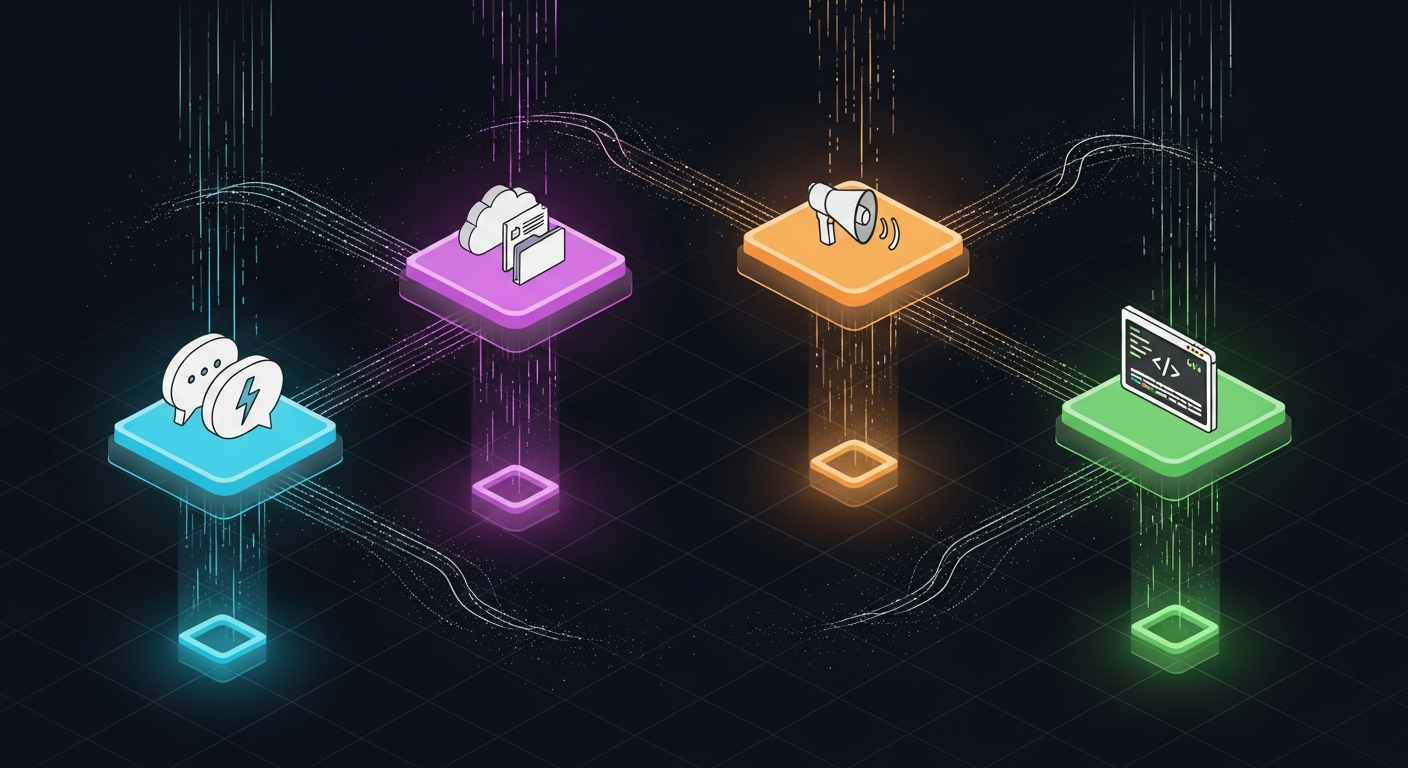
The Four Pillars of Business AI
For most businesses, four capabilities deliver 80% of the value:
- Communication Hub (Telegram): Mobile command center for interacting with agents
- Knowledge Base (Google Drive): Document automation and data extraction
- Growth Engine (Twitter/X via Postiz): Automated social media presence
- Development Platform (Claude Code): Ship features and fix bugs autonomously
Each pillar delivers 2-3x productivity gains individually. Orchestrated together? You’re looking at 10x+. More on why later.
The Economics: $30/Month vs $300K/Year
Let’s compare the traditional approach to the AI infrastructure approach:
Traditional Team (Annual Costs)
- Junior Developer: $80K + $24K benefits = $104K
- Customer Service Rep: $45K + $13.5K benefits = $58.5K
- Social Media Manager: $55K + $16.5K benefits = $71.5K
- Operations Coordinator: $50K + $15K benefits = $65K
- Total: $299K/year
AI Infrastructure Stack (Annual Costs)
- LLM API usage (Claude/GPT-4): $100-300/month
- Augmi platform (agent hosting): $20-50/month
- Tool integrations (Telegram, Drive, Postiz): $0-30/month
- Total: $1,440-$4,560/year
That’s a 98.5% cost reduction while maintaining (and often exceeding) output levels. Even if the AI stack delivers only 30% of human output, you’re still ahead on cost-per-unit-work.
The caveat? You still need humans for strategy, edge cases, and anything requiring judgment. AI handles execution; you handle direction. This is the “centaur” model—human + AI outperforming either alone.
Pillar 1: Telegram - Your AI Command Center
Why Telegram? Because in 2026, the best interface for managing your AI infrastructure isn’t a browser dashboard—it’s your phone.
Telegram’s Bot API has become the de facto standard for AI agent interaction. Unlike WhatsApp (closed, approval required) or Discord (rate limits, desktop-centric), Telegram offers:
- Open API: Deploy bots in minutes with zero approval process
- No rate limits: Unlike Discord’s 50 requests/sec or Slack’s tier limits
- Cross-platform: Seamlessly works on mobile, desktop, and web
- Rich interactions: Buttons, file uploads, inline keyboards for complex workflows
- End-to-end encryption: Secret chats for sensitive agent communications
How OpenClaw Integrates Telegram
Augmi’s OpenClaw agents connect to Telegram via a simple configuration. Here’s what’s possible:
Customer Service on Autopilot
- Customer messages your business Telegram account
- Agent receives message, processes via Claude
- Responds in under 3 seconds (humans average 5 minutes)
- Complex issues escalate to you with full context
- Result: 97% faster response time (industry data shows chatbots achieve this consistently)
Lead Qualification While You Sleep
- Prospect finds your website chat widget (connected to Telegram)
- Agent asks qualification questions (budget, timeline, fit)
- Hot leads trigger instant notification to your phone
- Cold leads enter automated nurture sequence
- Result: 40% increase in sales efficiency (reps focus on qualified leads only)
Mobile Task Delegation
- You’re at lunch, remember a task: “Create Jira ticket for login bug”
- Message your agent via Telegram (works with voice messages)
- Agent parses intent, creates ticket, confirms completion
- Result: 6+ hours/week saved on context switching
Proactive Status Monitoring
- Agent sends alerts: “Website response time degraded” or “Viral tweet detected”
- Daily summaries: “20 new signups, 5 support tickets, 3 PRs merged”
- On-demand queries: “How many active users this week?”
- Result: 85% faster time-to-response for critical issues
The Business Impact
The numbers are striking. Businesses using Telegram AI agents report:
- $120K-$219K annual savings vs human tier-1 support teams
- 97% reduction in average response time (from minutes to seconds)
- 24/7 availability without overtime or burnout
One indie hacker described their setup: “I manage my entire business via Telegram. Customer questions, team updates, server alerts—all routed to one chat. I built it in a weekend with Augmi. My phone is now mission control.”
The key insight: Telegram isn’t just a messaging app—it’s the interface layer between you and your entire AI stack.

Pillar 2: Google Drive - Your AI Knowledge Base
While others see Google Drive as “where files go to die,” forward-thinking operators are turning it into the nervous system of their AI infrastructure.
Why Drive? Because it’s already where your business data lives. Rather than fighting adoption, leverage ubiquity:
- 3+ billion users: Your team already uses it
- Free tier: 15GB included (enough for most small business documents)
- Real-time collaboration: Humans and AI editing the same docs simultaneously
- Version history: Track AI changes vs human changes
- Mature API: Well-documented, reliable, official SDKs
Document Automation Workflows
OpenClaw agents can monitor Drive folders and execute workflows when files change. Here are the highest-ROI patterns:
1. Data Extraction from PDFs
Traditional flow:
- Receive invoice PDF via email (5 minutes)
- Manually enter data into accounting system (15 minutes)
- Double-check for errors (5 minutes)
- Total: 25 minutes per invoice
AI-powered flow:
- Upload invoice to “Invoices” Drive folder (30 seconds)
- Agent detects new file via webhook
- Extracts vendor, amount, date, line items via Claude vision
- Writes to Google Sheet automatically
- You review for accuracy (2 minutes)
- Total: 2.5 minutes per invoice (10x faster)
Result: Deloitte research shows this pattern delivers 34% reduction in manual data entry errors and saves 240 hours annually per knowledge worker.
2. Auto-Organization of Documents
Your Drive is chaos. 500 unsorted files in random folders. Hiring someone to organize it would cost $500+ and take a week.
AI agent approach:
1. Agent scans Drive for uncategorized files
2. Claude analyzes content → determines category
3. Moves to appropriate folder (creates folders if needed)
4. Adds metadata tags for searchability
5. Generates folder structure based on content patterns
Time: 30 minutes of agent work (running in background). Cost: $2 in API calls. Result: Instantly searchable knowledge base.
3. Automated Report Generation
You need weekly sales reports. Currently: spend 3 hours Friday afternoon pulling data from Sheets, writing summaries, formatting in Docs, emailing to stakeholders.
AI agent workflow:
schedule: "Every Friday 9 AM"
steps:
  - Pull sales data from Google Sheet "Weekly-Sales-2026"
  - Generate narrative summary via Claude
  - Insert charts and format in Google Doc template
  - Share with stakeholders automatically
  - Send Telegram notification when complete
Human time required: 10 minutes to review before sending. Time saved: 2.5 hours every week = 130 hours/year.
4. Workflow Triggers
Every time a sales rep uploads a signed contract to the “Closed Deals” folder:
- Agent detects new file
- Extracts customer info → creates CRM record
- Triggers welcome email sequence
- Schedules onboarding kickoff call
- Notifies finance team via Telegram
- Adds customer to product access list
Traditional approach: 45 minutes of manual work across 3 departments. AI approach: 2 minutes of autonomous execution. Result: 80% faster customer onboarding.
The Compound Value of Structured Knowledge
The real power isn’t individual automations—it’s that your Drive becomes a queryable knowledge base.
Instead of searching for “that document from Q3 with the pricing info,” you ask your agent:
“What was our pricing strategy for enterprise customers in Q3 2025?”
The agent scans Drive, synthesizes relevant docs, and returns a structured answer with sources. This is what Google’s Gemini integration promises, but you can build it today with OpenClaw.
Pillar 3: Twitter/X - Your AI Growth Engine
Social media is either a growth engine or a time sink—the difference is automation.
In 2026, businesses save 6+ hours per week using AI for social media management. But most are still doing it wrong: batch-creating generic posts that scream “AI-generated.”
The right approach? AI as amplifier, not replacement. You provide the ideas; AI handles the execution, optimization, and scheduling.
Why Twitter for Business Development?
Despite competition from TikTok and LinkedIn, Twitter remains the highest-ROI platform for B2B growth:
- 500M+ daily active users (increasingly professional audience)
- Algorithmic virality: One good tweet can reach millions
- Real-time conversations: Perfect for thought leadership and trend-jacking
- Direct customer access: No email gate; instant DMs
- SEO benefit: Tweets indexed by Google (brand visibility beyond platform)
AI-Powered Social Media Workflow
Here’s how OpenClaw agents + Postiz skill transform your social presence:
1. Content Generation from Bullet Points
You have expertise but hate writing tweets. Traditional solution: hire social media manager ($60K/year).
AI solution:
1. You jot notes in Google Doc: "Launched new feature - one-click agent deployment"
2. Agent monitors Doc for changes
3. Claude expands bullets into tweet thread (3-5 tweets)
4. Generates 3 variations with different angles
5. You review in Telegram, approve best version
6. Posts via Postiz at optimal engagement time
Time: 5 minutes to write bullets, 2 minutes to review. Quality: In your voice (trained on your previous tweets). Volume: 5x increase in posting frequency.
2. Hashtag Optimization
Random hashtags = random reach. AI analyzes trending topics in your niche and suggests optimal tags.
Example: You’re tweeting about AI agents. Agent checks:
- Current trending hashtags (#AI, #Automation, #NoCode)
- Your historical best-performing tags (#BuildInPublic, #IndieHackers)
- Competitor usage patterns
Suggests: #AIAgents #BuildInPublic #NoCode #Automation
Result: 40% increase in discoverability (your tweets appear in more searches).
3. Optimal Timing & Scheduling
Posting at 3 AM when your audience is asleep? You’re wasting good content.
Agent workflow:
1. Analyze when your followers are most active (Twitter API data)
2. Identify peak engagement windows (9 AM, 1 PM, 7 PM in your case)
3. Auto-schedule posts to hit those windows
4. Adjust based on performance (machine learning over time)
Result: Studies show 3-5x increase in engagement rate with same content, better timing.
4. Engagement Automation
Manually responding to every mention is impossible at scale. Ignoring them kills growth.
AI approach:
1. Monitor @mentions via Twitter API
2. Analyze sentiment (positive/negative/neutral)
3. Positive mentions → Auto-draft thank you reply
4. Questions → Auto-draft helpful response
5. Negative mentions → Route to human immediately
6. Send drafts to Telegram for approval
7. Post approved replies
Result: 97% faster response time. Followers perceive you as highly engaged (because you are, via AI proxy).
5. Analytics & Iteration
Which tweets drive traffic? Which get ignored? Most people never analyze this.
Agent workflow:
1. Pull analytics for all tweets (views, engagement, clicks)
2. Identify patterns (threads vs single tweets, topics, formats)
3. Generate weekly report: "Tweets about X got 3x engagement"
4. Adjust content strategy accordingly
Result: Data-driven social strategy. Focus on what actually works.
The Authenticity Question
Legitimate concern: “Won’t AI tweets feel soulless?”
The solution isn’t avoiding AI—it’s using it right:
- ❌ Wrong: Fully automated posting with zero human input (spammy, inauthentic)
- ✅ Right: AI drafts, you edit/approve, AI handles posting/scheduling (leveraged authenticity)
As indie hacker Pieter Levels put it: “I write bullet points, Claude expands to tweets, I approve. 10x output, still authentic.”
The goal isn’t to fake being human—it’s to amplify your authentic ideas through AI leverage.
Pillar 4: Claude Code - Your AI Developer
This is where personal AI infrastructure gets truly exponential.
Claude Code has achieved a $1 billion annualized revenue run rate since launch. The stat that matters more: 67% of developers who try it keep using it (Anthropic data). That retention rate signals genuine productivity gains, not hype.
Andrej Karpathy (former Tesla AI lead) captured the shift: “80% of my coding is now done by AI agents, and the trend is clear.” This isn’t junior developers using autocomplete—this is world-class engineers delegating implementation to AI.
What Claude Code Actually Does
It’s not GitHub Copilot (autocomplete). It’s an autonomous agent that writes, debugs, and ships code.
Key capabilities:
- Autonomous feature implementation: Describe what you need → Claude writes code → commits PR
- Debugging from screenshots: Share error → Claude identifies issue → fixes
- Refactoring legacy code: “Modernize this codebase” → Claude rewrites with best practices
- Automatic test generation: Claude writes unit tests for code it generates
- Documentation creation: Generates docstrings, README files, architecture diagrams
The Developer Productivity Multiplier
Traditional coding workflow (without AI):
- Read requirements (30 min)
- Research implementation approach (1 hour)
- Write code (3 hours)
- Debug issues (2 hours)
- Write tests (1 hour)
- Document (30 min)
- Code review iterations (1 hour) Total: 9 hours per feature
AI-assisted workflow (with Claude Code):
- Describe requirements to Claude (5 min)
- Review generated code (15 min)
- Claude auto-debugs with human feedback (30 min)
- Claude writes tests (10 min review time)
- Claude generates docs (5 min review)
- Code review (30 min) Total: 1.5 hours per feature
That’s 6x faster for standard features. The speedup varies by complexity (simple CRUD: 10x, novel algorithms: 2x), but even conservative estimates show 3-4x gains.
The Business Case for Non-Developers
“But I’m not a developer—why do I care?”
Because having AI development capability unlocks business models impossible for non-technical founders:
Before Claude Code:
- Want to build a SaaS? Need to hire developer ($120K/year) or learn to code (6-12 months)
- Want custom automation? Pay agency $10K-50K for one-time project
- Want to iterate fast? Blocked by developer availability
With Claude Code:
- Describe feature in plain English → Ships in hours, not weeks
- Custom automation costs $20/month (Claude subscription) vs $10K agency project
- Iterate instantly (no waiting for developer to have time)
You don’t need to become a developer—you need to become literate enough to direct AI development. The skill shifts from “writing code” to “knowing what to build and how to evaluate it.”
Real-World Example: Augmi Itself
Meta point: Augmi was built using Claude Code.
The OpenClaw deployment system (container orchestration, health monitoring, gateway auth) was largely AI-generated. Human developers focused on:
- Architecture decisions (how should this work?)
- Edge case handling (what could go wrong?)
- Integration design (how do pieces connect?)
Claude handled:
- Implementation (turning decisions into code)
- Test coverage (writing unit tests)
- Documentation (explaining how it works)
Result: Shipped in weeks what would have taken months with traditional development. The AI didn’t replace developers—it multiplied their leverage.
The Coding Flywheel Effect
Here’s where it gets exponential:
Traditional development: Linear productivity. Hire 5 developers → 5x output.
AI-assisted development: Compound productivity.
- Use AI to build features faster
- Build AI tooling with the time saved
- Better AI tooling enables more complex features
- More features = more users = more data
- More data improves AI capabilities
- Improved AI enables even faster development Repeat
This is why AI coding tools are the fastest-growing software category (52% CAGR). Every software company is becoming an AI company because you need AI to compete on velocity.
Gartner predicts 40% of enterprise applications will be AI-augmented by 2027. The laggards will struggle to keep up.
The Compound Effect: When 4 Agents Work Together
Here’s the unlock: 4 integrated tools aren’t 4x more productive—they’re 10x+ more productive.
Why? Because each tool multiplies the others’ capabilities.

Linear vs Exponential Thinking
Linear scaling (traditional hiring):
- Hire 4 people → each works independently → 4x output
- Coordination overhead reduces total to ~3.2x
- Cost: $300K/year
Exponential scaling (AI orchestration):
- Deploy 4 agents → they work together → 10x+ output potential
- Coordination is automated (no overhead)
- Cost: $3K/year
The difference is orchestration—agents feeding data to each other, creating feedback loops.
Real-World Orchestration Example
Scenario: You’re launching a new product feature.
Without orchestration (linear):
- Write announcement post manually (1 hour)
- Post to Twitter manually (5 min)
- Respond to questions manually (30 min ongoing)
- Update documentation manually (1 hour)
- Monitor for bugs manually (ongoing) Total human time: 2.5+ hours upfront + ongoing monitoring
With orchestration (exponential):
1. Claude Code ships feature → writes technical docs automatically
2. Google Drive agent detects new docs → extracts key points
3. Twitter agent generates announcement tweet from key points
4. Posts at optimal time automatically
5. Telegram agent monitors Twitter for questions → routes to you
6. You answer via Telegram → Agent posts reply to Twitter
7. Claude Code monitors error logs → Telegram alerts if issues detected
8. Customer questions via Telegram → Agent references Drive docs for answers
Total human time: 15 minutes (approve tweet, answer complex questions)
Each agent amplifies the others:
- Claude Code provides data → Drive structures it
- Drive provides content → Twitter distributes it
- Twitter generates conversations → Telegram aggregates them
- Telegram surfaces priorities → Claude Code fixes issues
This is the compounding effect: Output increases non-linearly as tools integrate.
The Feedback Loop
The real magic happens over time:
Week 1: Agents execute based on your initial instructions Week 2: Analytics show which content performs best → Twitter agent adjusts strategy Week 3: Customer questions reveal documentation gaps → Drive agent updates docs Week 4: Improved docs reduce question volume → More time for strategic work Week 5: More strategic work → Better product decisions → Faster growth
Result: Each week is more efficient than the last. This is how solopreneurs compete with teams.
The Math
Conservative estimate with 4 integrated agents:
| Without AI | With AI | Multiplier |
|---|---|---|
| Customer service: 10 hrs/week | 2 hrs/week | 5x |
| Social media: 8 hrs/week | 1 hr/week | 8x |
| Documentation: 6 hrs/week | 1 hr/week | 6x |
| Development: 20 hrs/week | 5 hrs/week | 4x |
| Total: 44 hrs/week | 9 hrs/week | 4.9x |
But that’s linear thinking. The compound effect:
- Time saved on customer service → invest in better product
- Better product → more word-of-mouth growth
- More growth → more data for AI to learn from
- Better AI → even more time savings Result: 10x+ over 6-12 months
Getting Started with Augmi
Ready to build your personal AI infrastructure? Here’s the path from zero to operational in under an hour.
Step 1: Create Your Account
- Visit augmi.world
- Connect wallet (MetaMask, Coinbase Wallet, WalletConnect)
- Sign message to authenticate (no password needed)
Why wallet auth? Because Phase 2 of Augmi gives your agents their own crypto wallets for autonomous payments. Starting with wallet login means seamless upgrade path.
Step 2: Deploy Your First Agent
- Click “Create Agent” in dashboard
- Choose framework: OpenClaw (AI agent framework)
- Name your agent (e.g., “Business-Command-Agent”)
- Add your Anthropic API key (get free credits at console.anthropic.com)
- Click “Deploy”
Behind the scenes: Augmi spins up a Fly.io machine running OpenClaw with persistent storage. You get:
- Dedicated container (always-on, not shared)
- 1GB persistent volume for agent state
- Public preview URL for Control Panel
- One-time access code for initial authentication
Time to deploy: ~60 seconds
Step 3: Connect Channels
Add Telegram:
- Create bot via @BotFather
- Copy bot token
- In Augmi dashboard → Channels → Add Telegram
- Paste token → Save
- Message your bot: “Hello!” Your agent responds in ~3 seconds
Add Google Drive:
- Create Google Cloud service account
- Download credentials JSON
- In Augmi dashboard → Channels → Add Google Drive
- Upload credentials → Select folders to monitor
- Agent now watches for file changes
Add Twitter (via Postiz):
- Deploy Postiz (self-hosted or use postiz.com cloud)
- Connect your Twitter account to Postiz
- Get Postiz API key
- In Augmi dashboard → Skills → Add Postiz
- Enter API key → Configure posting schedule
Add Claude Code:
- Subscribe to Claude Code ($20/month at claude.ai/code)
- Create developer agent in Augmi
- Connect to your GitHub repo
- Agent can now write code via Telegram commands
Total setup time: ~30 minutes (one-time configuration)
Step 4: Configure Your First Workflows
Start simple. Three high-ROI workflows:
Workflow 1: Daily Summary (5 min to configure)
Schedule: Every day at 9 AM
Action: Agent sends Telegram message with:
  - Unread emails count (via Gmail API)
  - Upcoming meetings (via Google Calendar API)
  - New social media mentions (via Twitter API)
Workflow 2: Customer Question Router (10 min)
Trigger: New message to business Telegram
Action:
  - Agent analyzes question
  - If simple → Answers from knowledge base in Drive
  - If complex → Routes to you with suggested response
  - You approve → Agent posts reply
Workflow 3: Weekly Report Automation (15 min)
Schedule: Every Friday at 5 PM
Action:
  - Pull data from Google Sheet "Weekly-Metrics"
  - Generate summary via Claude
  - Create Google Doc with charts
  - Share with team
  - Send Telegram notification when ready
These three workflows alone save 5-8 hours per week. Payback period: Week 1.
Step 5: Scale Over Time
Don’t build everything at once. Add incrementally:
Month 1: Basic workflows (summaries, question routing) Month 2: Social media automation (Twitter posting) Month 3: Document automation (Drive workflows) Month 4: Development automation (Claude Code integration)
By Month 4, you’re operating at 10x leverage.
Cost Breakdown
Minimum viable stack:
- Augmi platform: $20/month (hosting + orchestration)
- Claude API: $50/month (typical usage)
- Telegram: Free
- Google Drive: Free (15GB tier)
- Twitter posting: Free (manual) or $19/month (Postiz cloud) Total: $70-90/month
Advanced stack (high volume):
- Augmi platform: $50/month (premium tier)
- Claude API: $200/month (heavy usage)
- Postiz self-hosted: $0 (or $19/month cloud)
- Claude Code subscription: $20/month
- Additional integrations: $30/month Total: $300/month
Even the advanced stack costs less than one week of employee salary.
The Future: Agent Wallets and Autonomous Operations
You’re building infrastructure today that unlocks tomorrow’s capabilities.
Augmi Phase 2 (launching Q2 2026) introduces agent wallets—each agent gets its own crypto wallet to hold, send, and receive tokens.

What Agent Wallets Enable
Autonomous API Payments Your agent runs out of Claude API credits. Instead of you manually topping up:
- Agent detects low balance
- Purchases more credits using its wallet
- Sends you Telegram receipt notification You never ran out of service
Agent-to-Agent Transactions Your Twitter agent generates viral content. Your analytics agent wants to buy that content strategy data:
- Analytics agent offers 10 USDC for Twitter agent’s performance dataset
- Twitter agent accepts (based on rules you set)
- Transaction completes autonomously
- Both agents improve from the exchange Agents form their own economy
Micropayment Monetization Your customer service agent is really good. Other businesses want to use it:
- List agent on Augmi marketplace (Phase 3 roadmap)
- Other businesses pay $0.10 per query
- Your agent earns while helping their customers
- Revenue flows to your wallet automatically Your agent becomes a revenue stream
x402 Protocol Integration
Augmi is integrating with the x402 protocol (HTTP 402 Payment Required)—enabling agents to pay for premium APIs automatically.
Example:
- Your agent needs real-time market data (premium API)
- API requires $0.01 per request (x402 enabled)
- Agent pays from its wallet via Lightning Network
- Gets data instantly (no subscription needed) Agents pay-as-they-go for exactly what they use
This unlocks a future where agents are truly autonomous—not just executing tasks, but managing their own economics.
The Vision: Upwork for AI Agents
Augmi Phase 3 (roadmap 2027) includes an agent marketplace modeled on Upwork:
- Businesses post jobs: “Need 24/7 customer service agent”
- Agents apply: “I’m trained on your docs, can start immediately, $50/month”
- Businesses hire: Agent starts working, pays from escrow
- Performance tracking: Ratings, reviews, reputation scores
The best agents earn more. Market competition drives quality. Humans oversee, but agents do the work.
This isn’t science fiction. The primitives exist today:
- ✅ AI agents capable of complex tasks (OpenClaw, Claude)
- ✅ Crypto payments infrastructure (USDC, Lightning)
- ✅ Reputation systems (on-chain verifiable)
- ⏳ Market coordination (Augmi is building this)
Conclusion: Personal AI Infrastructure is the New Competitive Advantage
The businesses thriving in 2026 aren’t the ones with the biggest teams—they’re the ones with the most sophisticated AI infrastructure.
While your competitors are posting job listings and conducting interviews, you’re deploying agents that work 24/7, never take PTO, and cost less than a phone bill.
The four-pillar stack (Telegram, Drive, Twitter, Claude Code) isn’t the end goal—it’s the foundation:
- Telegram: Your mobile command center (manage everything from your phone)
- Google Drive: Your knowledge base (documents that work for you)
- Twitter/X: Your growth engine (visibility while you sleep)
- Claude Code: Your developer (ship features at AI speed)
Each pillar delivers 2-3x gains individually. Orchestrated together: 10x+ through compound effects.
The economic math is overwhelming:
- Traditional team: $300K/year
- AI infrastructure: $1K-5K/year
- Performance: 30-100% of human output (depending on task)
- ROI: 60-300x
More important than cost savings is velocity. With AI infrastructure, you can:
- Test 10 ideas in the time it takes others to test 1
- Respond to market changes in hours, not weeks
- Operate at “team scale” while staying lean
- Compound advantages over time (AI gets better as it learns)
The question isn’t whether to build personal AI infrastructure—it’s how fast you can deploy it before competitors do.
Start Small, Scale Fast
You don’t need to build everything at once:
Week 1: Deploy agent, connect Telegram, set up basic commands Week 2: Add Google Drive monitoring for one workflow Week 3: Connect Twitter for automated posting Week 4: Integrate Claude Code for development tasks
By Week 4, you’re operating at 5-10x your previous capacity. By Month 3, you’re competing with teams 10x your size.
The tools exist. The infrastructure is proven. The only question is: will you be among the early adopters who establish dominance, or the late majority playing catch-up?
Your competitors are hiring teams. It’s time to deploy agents.
Get started at augmi.world
Augmi is a crypto-native AI agent platform that makes deploying, managing, and monetizing AI agents accessible to everyone. Built on OpenClaw, powered by Claude, and secured by crypto rails. Join the personal AI infrastructure revolution.