
I Ship Code I Never Read: The New Reality of AI-Assisted Development
February 2026
Peter Steinberger dropped a bombshell confession:
“📢 Confession: I ship code I never read. Here’s my 2025 workflow.”
The internet had opinions. Some called it reckless. Others called it inevitable. The truth is more nuanced—and more important—than either take suggests.
Here’s what’s actually happening, why it works, and when it doesn’t.
The Confession That Divided Developers
Steinberger isn’t some junior dev YOLO-ing his way through a side project. He’s built companies, shipped major products, and has decades of experience. When someone like that says “I ship code I never read,” it’s worth understanding what they actually mean.
The key insight: “never read” doesn’t mean “never verified.”
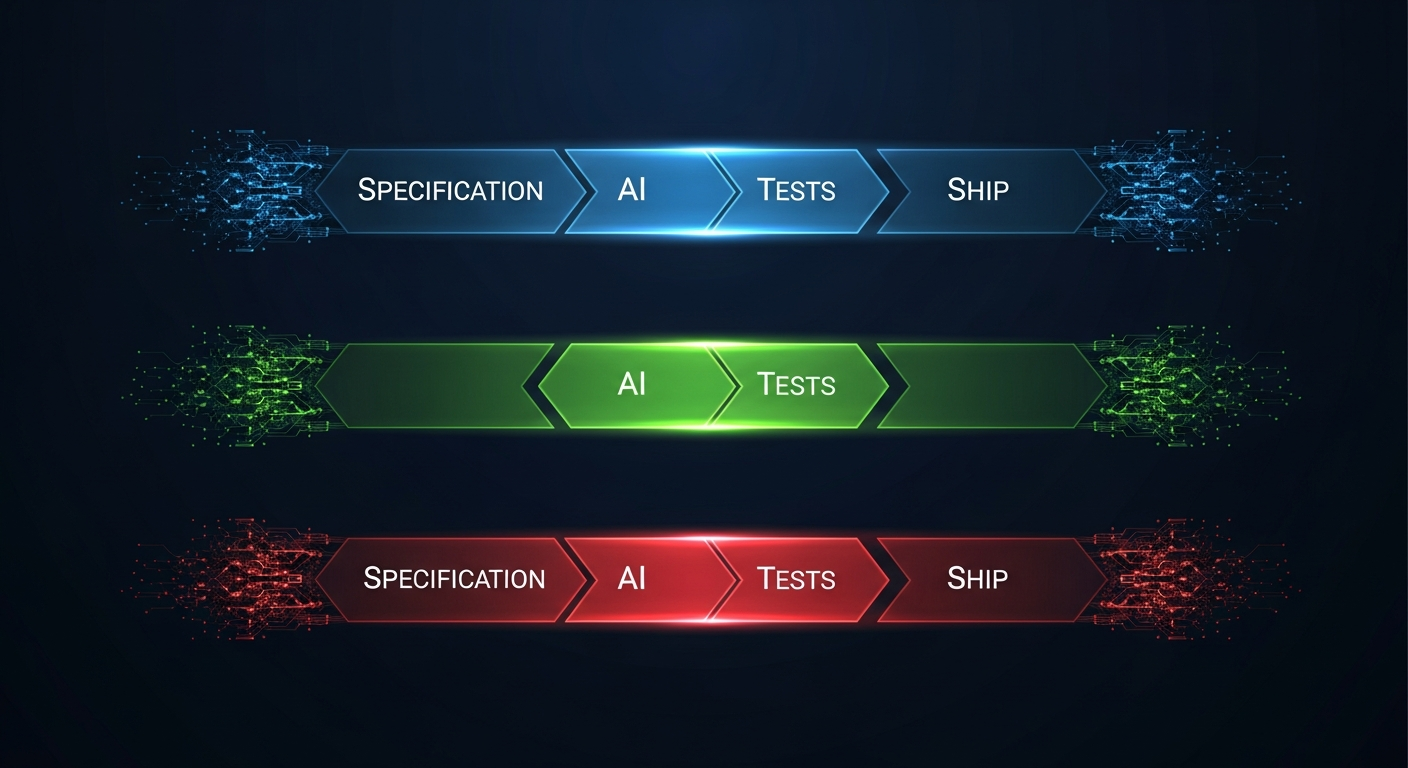
The workflow looks something like this:
- Write a clear specification of what you want
- Let AI generate the implementation
- Run comprehensive tests
- Review behavior, not syntax
- Ship if it works correctly
The code itself? Often skimmed at best. Sometimes not read at all.

Why This Isn’t As Crazy As It Sounds
You Already Do This (Sort Of)
When you import a library, do you read every line of source code? When you use a framework, do you audit the internals? When you copy from Stack Overflow, do you trace through every edge case?
Of course not. You trust that:
- The code has been tested
- Others have used it successfully
- The behavior matches the documentation
AI-generated code is just another layer of abstraction. The question isn’t whether to trust code you didn’t write—you already do. The question is what verification makes that trust warranted.
Tests Are Better Than Reading
Here’s a controversial truth: for most code, tests catch more bugs than code review.
Reading code tells you what it says. Tests tell you what it does.
A developer can stare at a function for an hour and miss a subtle off-by-one error. A test suite will catch it in milliseconds.
This doesn’t mean code review is worthless—it catches architectural issues, security problems, and maintainability concerns that tests miss. But for “does this code do what I asked?”, tests win.
Specification Is The Bottleneck
When you’re writing specifications clear enough for AI to implement correctly, you’re doing the hard work.
The mental labor of programming isn’t typing syntax. It’s:
- Understanding the problem
- Defining the requirements
- Handling edge cases
- Making architectural decisions
If your spec is precise enough for AI to generate working code, you’ve already done 80% of the cognitive work. Reading the generated implementation is often just checking AI’s homework.
The Workflows That Make This Work
Workflow 1: Test-Driven AI Development
1. Write failing tests for desired behavior
2. Commit tests
3. Ask AI to make tests pass
4. Review diff (if curious)
5. Run full test suite
6. Ship
The tests ARE the specification. If AI writes code that passes your tests, it—by definition—does what you asked.
Workflow 2: Behavior-Driven Verification
1. Describe feature in natural language
2. AI generates implementation
3. AI generates test scenarios from description
4. Run AI-generated tests
5. Manually verify key behaviors
6. Ship
Here you’re trusting AI to both implement AND verify. This works when you can spot-check critical paths.
Workflow 3: Continuous Micro-Shipping
1. Make small, focused requests
2. AI implements
3. Quick manual verification
4. Ship immediately
5. Repeat
The smaller the change, the lower the risk of unread code causing problems. If something breaks, you know exactly what change caused it.
When NOT To Ship Unread Code
This approach isn’t universal. Some code demands human review:
Security-Critical Code
Authentication, authorization, encryption, input validation—this code needs human eyes. The consequences of bugs are too severe, and AI can subtly miss security requirements.
Complex Business Logic
When the “specification” is actually a conversation with stakeholders that uncovered nuance over weeks, AI doesn’t have that context. The implementation might be technically correct but miss the actual business intent.
Performance-Sensitive Paths
AI might generate code that works but is O(n²) when it should be O(n). Tests won’t catch this unless you’re specifically testing performance.
Code You’ll Need To Debug Later
If something goes wrong at 3 AM, you need to understand the code well enough to fix it. Shipping code you’ve never read means potentially debugging code you don’t understand.
Long-Lived Infrastructure
Code that will run for years and be maintained by future developers should be understood, documented, and intentionally architected.
The Skills That Matter Now
If reading every line isn’t required, what skills DO matter?
1. Specification Writing
The ability to clearly articulate what you want—precisely enough that AI can implement it correctly. This is harder than it sounds.
Bad spec: “Add user authentication” Good spec: “Add email/password authentication with bcrypt hashing, JWT tokens (1hr expiry), refresh token rotation, and rate limiting (5 attempts/minute/IP)”
2. Test Design
Knowing what to test, how to test it, and what edge cases matter. If your tests are comprehensive, unread code is safe. If they’re not, it isn’t.
3. Architectural Thinking
AI generates functions. Humans design systems. Understanding how pieces fit together, what abstractions are appropriate, and where boundaries should be—this is human work.
4. Verification Instincts
Knowing when to trust AI output and when to dig deeper. Experienced developers develop a sense for when something feels off, even if they can’t articulate why.
5. Debugging Intuition
When things break, you need to find the problem. This requires understanding systems well enough to form hypotheses, even if you didn’t write every line.
The Cultural Shift
The debate over shipping unread code is really a debate about identity.
For decades, developers were valued for their ability to write code. The craft was in the syntax, the algorithms, the elegant implementations.
Now, the craft is shifting. Writing code is becoming a commodity. What’s valuable is:
- Knowing what to build
- Verifying it’s built correctly
- Shipping it quickly
- Iterating based on feedback
This is uncomfortable for developers whose identity is tied to “being the one who writes the code.” But it’s liberating for those focused on outcomes.
The Middle Path
The most effective developers aren’t on either extreme.
They don’t read every line of AI-generated code. That’s too slow.
They don’t ship everything blind. That’s too risky.
Instead, they:
- Read code when it matters — security, complexity, architecture
- Test rigorously always — the universal safety net
- Trust AI for the mundane — boilerplate, standard patterns
- Stay curious — occasionally reading generated code to learn and calibrate trust
- Ship fast, fix fast — small iterations reduce risk
This isn’t about being lazy. It’s about being strategic with attention.
What This Means For The Industry
If shipping unread code becomes normal, several things follow:
Testing Becomes Non-Negotiable
The main safeguard against unread code is comprehensive testing. Teams without good test coverage can’t safely adopt this workflow.
Specification Formats May Evolve
If specs are the new source of truth, we might see more formal specification languages or structured prompting formats.
Code Ownership Changes Meaning
“Owning” code increasingly means understanding its behavior and being responsible for its correctness—not having written every line.
Junior Developers Enter Differently
The entry point might shift from “learn syntax, write basic code” to “learn to specify, test, and verify.” Different skills, different mentorship needs.
The Augmi Perspective
At Augmi, we see this shift every day. Our users deploy AI agents that do real work—often generating code, automating workflows, and making decisions.
The key insight: trust comes from verification infrastructure, not from reading every output.
Our platform provides:
- Isolated execution — agent actions can’t escape their container
- Audit logs — see what your agent did, even if you didn’t watch
- Behavioral testing — verify agent actions match intentions
- Quick iteration — small deployments, fast feedback
Whether it’s code or agent behavior, the principle is the same: build systems that verify correctness, and you can trust outputs you didn’t manually review.
The Takeaway
Peter Steinberger’s confession isn’t a flex. It’s a glimpse of where software development is heading.
The developers who thrive will be those who:
- Write clear specifications
- Build comprehensive tests
- Verify behavior, not syntax
- Ship confidently and iterate quickly
The code you ship doesn’t have to be code you’ve read. It has to be code you’ve verified.
That’s a subtle but profound difference.
Ready to ship faster with AI agents you can trust? Deploy in 60 seconds at augmi.world.